The Midwife Kept a Secret for 20 Years—Then One Photograph Exposed the Vasconcelos Family
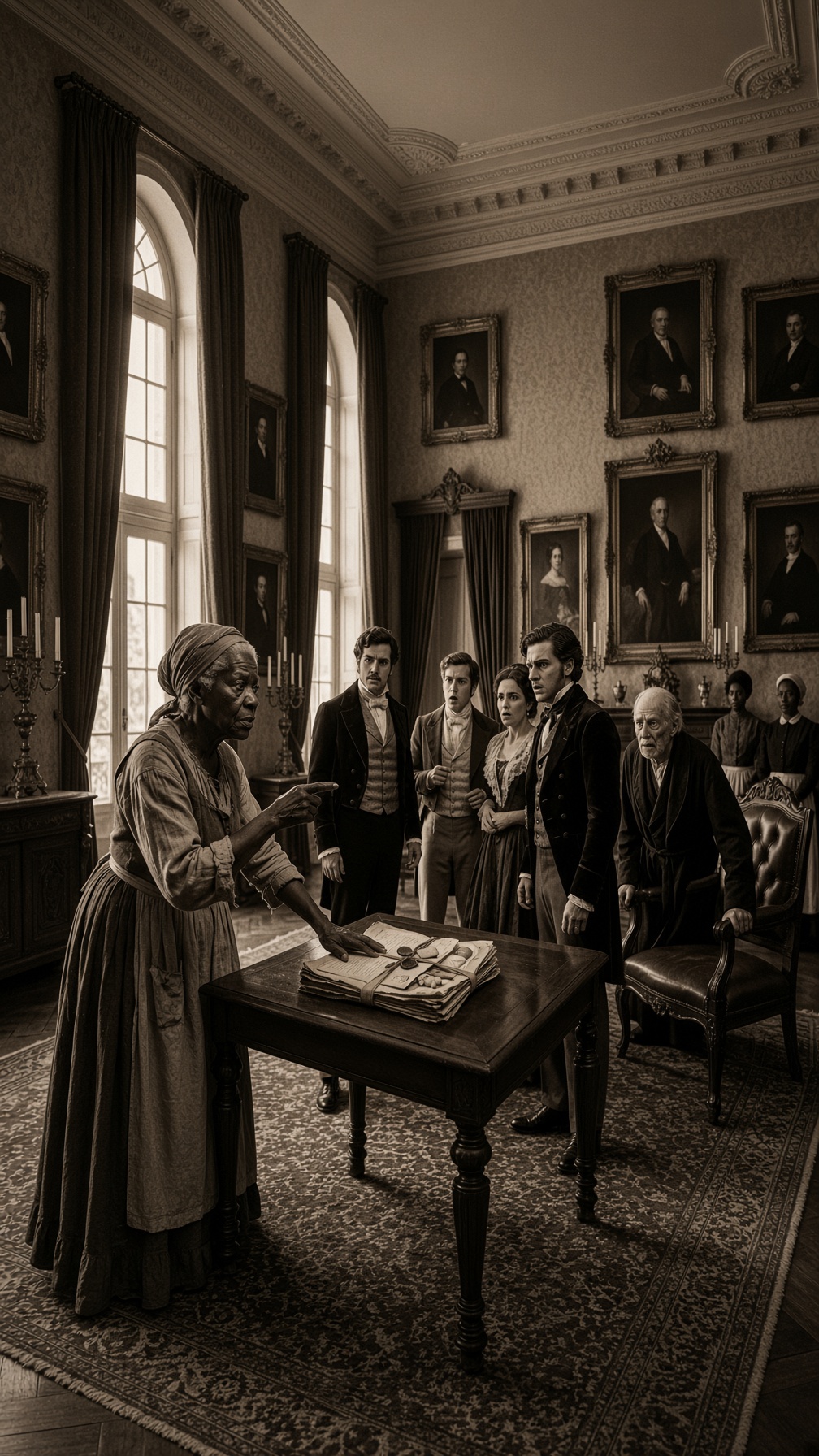
Dulce walked to the bedroom, opened a low drawer beneath some folded sheets, and found a brown envelope that had remained hidden since 2004. The adhesive tape had yellowed with age. Inside was a worn blue notebook, several handwritten pages, and a faded 3×4 photograph showing two women standing in a maternity hospital corridor. One wore a simple hospital gown. Her face was swollen with exhaustion, and her eyes were lowered. The other woman wore an expensive robe and stood with an unmistakable air of confidence. Behind them was a baby carriage. In the lower corner was a date stamp from March 12, 2004. Dulce stared at the photograph for a long time. She had promised herself she would never look at it again. But now the hospital was disappearing, and with it came the possibility that the truth could vanish forever.
She opened the notebook to a page marked with a rusty paper clip. The entry was from her shift on March 12, 2004. Two women had been in labor that night. Clara Vasconcelos, 42 years old, was experiencing her third pregnancy. Her baby was premature, at 34 weeks, and had been diagnosed with a severe congenital heart condition. Neusa Santos, 28, was experiencing her first pregnancy. Her baby was carried to term and appeared healthy. Dulce’s handwritten notes recorded something deeply disturbing. Clara’s baby had been born alive but critically ill. Neusa’s baby had been born healthy, weighing approximately 3,200 grams. Yet the official record later stated that Clara Vasconcelos had delivered a healthy boy named Bernardo, while Neusa Santos had delivered a stillborn male child with no name.
Dulce remembered every detail. She remembered the smell of disinfectant, the sound of medical equipment, the frightened voices, and the confusion that filled the corridor. She remembered Clara Vasconcelos sitting on her bed with smudged makeup and a hard expression. She remembered Neusa Santos alone in another room, crying while holding a baby who was very much alive. She remembered being asked to sign documents that did not match what she had witnessed. She had refused. Because of that refusal, she was called before the hospital board and eventually pushed away from the situation.
For years, Dulce tried to forget. But the past returned when she switched on the television and saw the Vasconcelos family on the evening news. Hector Vasconcelos, the patriarch of the family’s textile empire, had died six months earlier. His death had triggered a bitter struggle among his three children over control of the company. The television showed Augusto Vasconcelos, the eldest, wearing an immaculate gray suit and speaking confidently about leadership and succession. He insisted that the firstborn naturally belonged at the center of the family’s business because that was how the Vasconcelos family had always operated.
Dulce immediately recognized the arrogance in his voice. It reminded her of Clara.
The next morning, Dulce returned to the address of the old Santa Cecilia Maternity Hospital. Construction barriers surrounded the property. Heavy machinery stood nearby, and workers were preparing the building for demolition. A security guard directed her to a temporary office inside a blue container where old files were being processed. Dulce showed her identification and requested copies of the records from her years at the hospital. She specifically wanted the patient files, duty rosters, and handwritten records from 2004.
Several days later, Dulce contacted Helena, an old social worker who had worked at the maternity hospital. She asked about Neusa Santos. The answer devastated her. Neusa had died approximately six years earlier from pneumonia. But Helena revealed something else. In 2017, Neusa had visited her and left an envelope with instructions. If Dulce ever came looking for her, Helena was supposed to give it to her.
Inside was a short letter written in Neusa’s trembling handwriting.
Neusa explained that her son had been born alive, strong, and healthy. Clara’s baby, by contrast, had been born with a severe heart defect and was not expected to survive. According to Neusa, Clara had come to her room and offered her money. She had argued that Neusa’s child would have a better life with an important family, while Clara’s own baby was going to die anyway. Neusa was poor, alone, deeply in debt, and terrified about the future. She made an impossible decision. She surrendered her living son and accepted the money.
The child’s name became Bernardo Vasconcelos.
Neusa wrote that she had seen Bernardo’s photograph in the newspaper years later. She knew he had grown up wealthy, but she had never stopped wondering whether she had made the right decision. Her letter contained one final request: if Dulce ever had the courage, she should tell Bernardo where he had really come from. He deserved to know.
Dulce now had three pieces of evidence: the photograph, Neusa’s letter, and the discrepancy between the original handwritten hospital record and the official registration.
She searched for Bernardo Vasconcelos and found his address. Unlike Augusto, Bernardo did not appear to occupy the center of the family’s world. When Dulce finally met him, he was dressed casually in a simple apartment. He looked tired. His dark eyes and brown hair gave him an appearance that did not strongly resemble Augusto or Lívia. But there was something in his expression that immediately reminded Dulce of Neusa.
Bernardo told her that he had never felt completely accepted by his family. His mother had always seemed distant. His father had been cold toward him. His siblings appeared to receive a kind of affection he never understood. He had spent much of his life wondering whether something about him was fundamentally wrong.
Dulce finally told him that she believed his entire identity had been built on a lie.
Before Bernardo could fully process what she meant, another complication arrived. Augusto had learned that someone was asking questions about the family. A lawyer soon appeared at Dulce’s apartment carrying an envelope. Inside was a substantial financial offer in exchange for silence and a promise that she would never discuss matters affecting the family’s reputation.
Dulce refused.
Instead, she demanded a meeting with all three Vasconcelos siblings.
On Friday morning, she entered the family’s corporate headquarters carrying her worn leather briefcase. Inside the glass meeting room, Augusto stood near the window in an immaculate suit. Lívia sat at the table, carefully observing the situation. Bernardo stood against the wall, clearly suspicious.
Dulce placed the old photograph on the table.
The room immediately became silent.
She explained that the photograph had been taken at Santa Cecilia Maternity Hospital on March 12, 2004. It showed Clara Vasconcelos and Neusa Santos in the same corridor. She then opened her notebook and described what she had witnessed during the births.
Clara’s son had been born alive but with a severe heart defect.
Neusa’s son had been born healthy.
The official documents told the opposite story.
According to the official registration, Clara had given birth to a healthy boy named Bernardo, while Neusa had supposedly lost her child.
Augusto immediately rejected the allegation. He argued that an old photograph proved nothing. It only showed that two women had been in the same hospital.
Dulce agreed that the photograph alone was not enough.
But she had something else.
She read Neusa’s letter aloud.
Every word changed the atmosphere in the room.
Lívia stared at the photograph. Bernardo became pale. Augusto remained rigid, refusing to accept what he was hearing.
Then Lívia revealed something she had remembered from childhood. When she was about twelve, she had once heard her mother, Clara, speaking while intoxicated. Clara had said that she had solved a problem that no one would ever discover. At the time, Lívia had dismissed the memory as something she had misunderstood.
Now she could no longer ignore it.
Dulce suggested a DNA test.
Augusto refused. He accused her of blackmail and threatened legal action. But Bernardo surprised everyone.
He agreed to take the test.
Lívia agreed as well.
Augusto left the room, refusing to participate.
For Bernardo, however, the test represented something much larger than an inheritance dispute. It represented the possibility of finally understanding why he had always felt like an outsider inside his own family.
Ten days later, the result arrived.
Bernardo and the Vasconcelos siblings did not share the expected paternal relationship. The DNA evidence showed that Bernardo was not biologically related to them in the way the family had always believed.
The revelation did not immediately solve anything.
Instead, it created another battle.
Augusto began legal proceedings, challenging Dulce’s account and attempting to remove Bernardo from the family’s inheritance structure. Lawyers argued over whether Bernardo’s years within the Vasconcelos household gave him rights independent of biological parentage. Lívia took a different position. She told Bernardo that blood did not erase the fact that they had grown up together. Whatever the documents said, she still considered him her brother.
Bernardo, meanwhile, was forced to confront the truth he had spent his entire life sensing without understanding.
His mother had not rejected him because he was unworthy.
His mother had given him away because she was desperate.
And Clara had apparently obtained the child she wanted by taking advantage of Neusa’s vulnerability.
Bernardo eventually asked Dulce for Neusa’s grave.
Several weeks later, he went there carrying flowers.
The cemetery was modest and located far from the wealthy neighborhoods associated with the Vasconcelos family. Neusa’s grave had a simple stone bearing only her name and dates. Bernardo stood silently in front of it for a long time.
Then he called Dulce and asked her to come with him.
Dulce accepted.
When they stood together beside Neusa’s grave, Bernardo finally had the opportunity to confront the woman who had given him life but had been absent from almost his entire existence.
He placed fresh flowers beside the stone.
He did not know exactly what he was supposed to say.
There was anger. There was sadness. There was gratitude. There was confusion. And there was the strange relief of finally knowing why so many pieces of his childhood had never seemed to fit together.
Dulce stood beside him quietly.
She had carried the secret for 20 years because she had been afraid of what powerful people could do to someone with nothing. Clara had frightened her. The family had influence. Her career had been threatened. She had believed that speaking out would destroy whatever life she had left.
But the demolition of Santa Cecilia Maternity Hospital had changed everything.
The building was disappearing.
The records were being digitized.
The people involved were growing older or dying.
And Dulce realized that if she remained silent, the truth might disappear with them.
For 20 years, she had kept the photograph hidden.
It had never been merely a memory.
It was evidence of a night when two mothers entered a maternity hospital expecting completely different futures—and when one decision changed the lives of several families forever.
Bernardo had spent his entire life believing that he was somehow the unwanted member of the Vasconcelos family. Now he understood that his story had begun somewhere else.
He was Neusa Santos’s son.
The wealthy name he carried had been given to him under circumstances he had never chosen.
And the woman who had surrendered him had spent the rest of her life wondering whether she had saved him or lost him.
As Dulce and Bernardo stood beside Neusa’s grave, he finally understood why Dulce had waited so long.
Twenty years had passed.
But the truth had not disappeared.
It had simply been waiting for someone brave enough to open an old envelope, unfold a faded photograph, and finally tell the story that powerful people had spent years trying to bury.
Disclaimer: This story is fictional and created for entertainment purposes only.
Any names, characters, places, or events are fictitious or used fictitiously.
No real person or organization is intended to be portrayed.