Cops Force Black Woman to Ground, Shave Her Head — Freeze When She Walks Into Their Trial as Judge
Cops Force Black Woman to Ground, Shave Her Head — Freeze When She Walks Into Their Trial as Judge 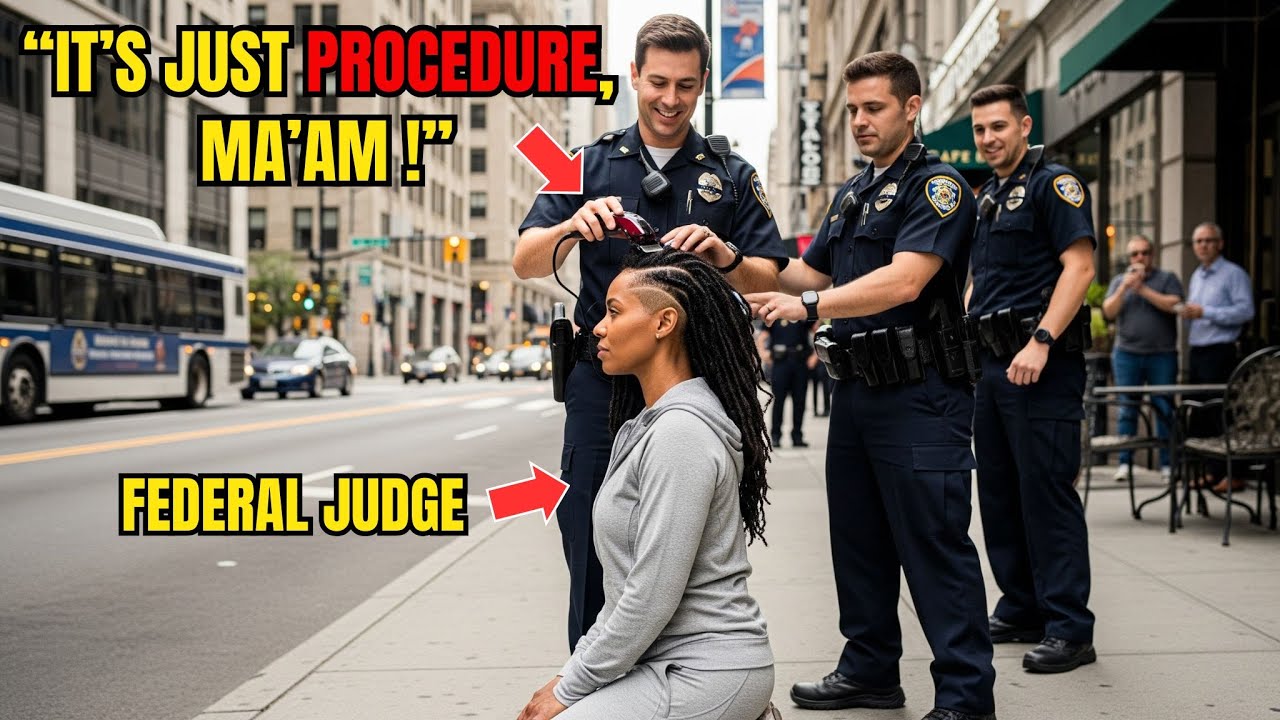
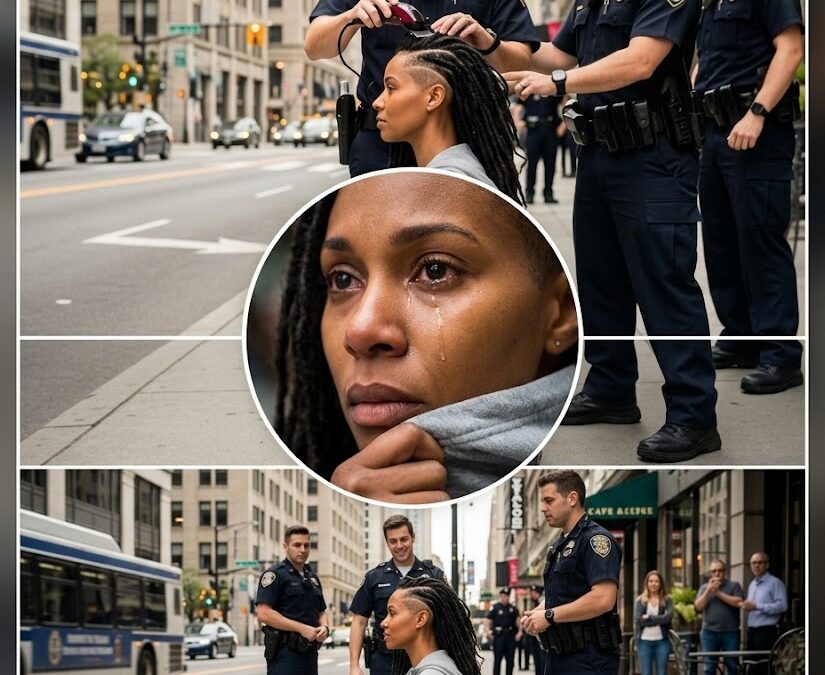
You filthy animal. You don’t belong here. Officer Pollson rips Grace from her car during a midday traffic stop downtown. She committed no violation. He doesn’t care. He grabs her neck, slams her face into the asphalt. His knee drives into her spine, pinning her flat against the ground. Pedestrians film on phones. Nobody intervenes.
Stevens Clippers. His partner pulls electric clippers from his belt. The buzz screams through the street noise. Pollson yanks Grace’s hair back, forces her face harder into concrete. This is what happens when your kind forgets their place. He shaves her head right there on the street. Hair scatters across asphalt as strangers watch in silence.
Grace doesn’t cry. She memorizes badge number 4883. Every face, every witness. What Officer Pollson doesn’t know about the woman he just humiliated could destroy everything he has. And in 8 weeks, it will. Eight weeks later, federal courthouse, courtroom packed. Media cameras line the back. Activists crowd the hallway.
Police union representatives fill the gallery stonefaced. The air crackles with tension. Everyone knows this trial matters. Officer Derek Pollson sits at the defendant table in a cheap suit. His hands shake. Officer Kyle Stevens stares at the floor beside him. Their attorney shuffles papers, tries to look confident. Fails. All rise.
The baiff’s voice cuts through the murmuring. Everyone stands. Silence falls except for rustling fabric and scraping chairs. The honorable judge Grace Hayes presiding. The door behind the bench opens. She enters. Judicial robes flow as she walks. Her head covered with an elegant silk head wrap. Gold fabric wrapped with precision.
She moves with quiet authority. Takes her position at the bench. Arranges her papers. Adjusts her microphone. Doesn’t look up yet. Pollson’s face drains of color. His mouth opens, but no sound comes. Stevens grabs the table edge, knuckles white, he leans toward their attorney, whispers something urgent, panicked, the attorney looks confused, glances at the judge, back at Stevens.
Recognition dawns like horror. Grace lifts her head. Her eyes scan the courtroom. Professional measured prosecution table, gallery, jury box. Then her gaze lands on the defendants, on officer Pollson, on officer Stevens. She holds their stare for 3 seconds, her expression unchanged. Cold judicial authority. Pollson tries to stand. His attorney yanks him down.
Stevens’s breathing becomes audible, rapid, trapped. The judge’s voice fills the courtroom. Calm, clear, powerful. The United States of America versus Derek Pollson and Kyle Stevens. Criminal civil rights violations under Title 18, Section 242. False arrest, assault under color of law. She pauses, lets the charges sink in.
Are the defendants ready to proceed? Their attorney’s voice cracks. Your honor, we we weren’t informed. That’s not what I asked, counselor. Silence. Are you ready to proceed? But we’re getting ahead of ourselves. 8 weeks ago on that downtown street, Grace was on the ground, hair scattered across asphalt, badge 4883 burned into her memory.
What happened between that moment and this courtroom? Let’s go back to where it all began. That afternoon started normal. Grace drives through downtown, returning from her mother’s house. Classical music plays softly. She’s relaxed, off duty, just casual clothes. Tuesday drive. Speedometer reads 32. Limit is 35. She signals every turn.
Does everything right. Blue lights flash behind her. No violation. Registration current. Insurance valid. She pulls over safely. Parks. Engine off. Hands on steering wheel. Officer Pollson approaches, hand on belt, face hard. License and registration now. Aggressive. Not professional. Of course, officer. May I reach into my glove compartment? Just get them.
She moves slowly, pulls out documents, hands them over. He snatches them, barely looks. Officer, why was I stopped? Speeding. I was going 32 in a 35 zone. His jaw tightens. She challenged him. Step out of the vehicle. On what grounds? Now she complies. Exit slowly, hands visible. I’m exiting voluntarily. I do not consent to any searches. His eyes narrow.
She knows her rights. Stevens, search the vehicle. Officer Stevens arrives. Looks uncertain. Sir, she refused consent. Search it. Officer, any search without probable cause violates my Fourth Amendment rights. Pollson steps closer. You think you’re a lawyer? I’m a citizen who knows the law. Then you know I can search with reasonable suspicion.
Terry v. Ohio requires articulable suspicion. You have none. His face flushes. She just cited Supreme Court case law. Steven searches, opens doors, checks seats, trunk, gym bag, groceries. Nothing. He returns, shakes his head. Nothing, sir. Pollson’s anger builds. Third car arrives. Officer William Blake. 8 months on the force.
You need backup, sir. Stay sharp. Blake senses something wrong. Pollson circles her car. I saw fertive movements. I was getting registration as requested. That’s not what I saw. He grabs her arm, spins her, forces her against the hood. Hot metal burns through her shirt. Sir. Stevens objects. Secure her. Blake’s body cam records everything.
He stands frozen. This escalated too fast. Grace stays steady. You’re violating my rights. Title 18, section 242. Assault under color of law. Across the street, an elderly woman pulls out her phone, starts recording. Pollson hears the citation. His rage peaks. Stevens, get the clippers. Stevens freezes. Sir, you heard me.
For what? Contraband concealment, hair search, drugs, tucked in curls. Complete lie. No such protocol. Blake’s hand hovers near his radio. Doesn’t press. Stevens returns with clippers. Never used like this. Pollson powers them on. The buzz screams. Grace looks him in the eye. You’re making a mistake. The only mistake is you thinking you have rights.
He grabs her hair, yanks her head back. She gasps. Blake steps forward, almost speaks, stops. Downtown traffic slows. People notice. Some pull out phones. Some walk faster. Pretend they don’t see. Nobody intervenes. Grace tries once more. Officer Pollson, badge 4883. I do not consent. This constitutes assault and deprivation of rights under federal law.
Perfect citation like someone who studies constitutional law. To Pollson, she’s just disrespectful. You’re about to learn respect. Clippers touch her scalp. Blake’s body cam captures it. Hair falling, her face, his expression, everything. Stevens looks away. The elderly woman keeps filming. Hands shaking. A businessman pauses. Records.
face showing disgust, doesn’t intervene. Pollson works methodically, strip by strip, taking time, making sure everyone sees. Humiliation as punishment. Grace closes her eyes, not from shame, from focus, counting, memorizing every second, every word, every witness. This is a federal crime and she’s documenting it with her mind.
Because Pollson doesn’t know Grace Hayes has photographic memory. Every detail recorded in the mind of a federal judge. Blake reaches for his radio. Finger touches the button. Stops. Career suicide. Reporting senior officers means exile. He drops his hand. Does nothing. Across the street, a mother covers her child’s eyes, but they saw it.
Hair falls in clumps. Dark coils on concrete. When the clippers stop, her scalp is bare. Pollson steps back. Now you look appropriate. She opens her eyes, looks at him with clarity. I hope you remember this moment, officer. Oh, I will. Best part of my day. But he won’t remember it fondly because in 8 weeks, every person on this street will be called to testify.
Every phone recording will be evidence. Every word he said will be read back in federal court, and the woman he just humiliated will be wearing judicial robes. Blake’s body cam captures the final moments. Grace standing, bald, dignified despite everything. She brushes hair off her shoulders, doesn’t cry, doesn’t beg. Am I free to go, officer? Pollson realizes he has nothing.
No violation, no drugs, no reason to arrest her. Get out of here. She gets in her car, starts the engine, drives away at exactly 32 mph. In her rear view mirror, the three officers stand there. Pollson looking satisfied, Stevens uncomfortable, Blake staring at the ground. None of them know what they just did. None of them know who she is. They’re about to find out.
Grace drives three blocks, pulls into a parking garage, parks, sits in silence. Her hands finally shake. The adrenaline crashes. She touches her bare scalp, feels the violation, the humiliation, the rage. But underneath the emotion, her legal mind is already working. Title 18, section 242, civil rights violation, assault under color of law, false detention, fourth amendment violation.
14th amendment equal protection violation. She has witnesses, multiple recordings, badge numbers, names. She pulls out her phone, calls her personal attorney. This is Grace Hayes. I need you to file a formal complaint with internal affairs, federal civil rights violation. I’ll send you everything. Her attorney knows who she is, knows what this means.
Judge Hayes, are you okay? I will be after justice is served. She hangs up, looks at herself in the mirror, bald, different, but unbroken. Officer Pollson wanted to humiliate her, to put her in her place. He succeeded in one thing. He made her angrier than she’s ever been. And anger in the hands of a federal judge is a dangerous thing.
Grace stands on the sidewalk, bald, humiliated, hair scattered at her feet. Pollson isn’t finished. He walks to his patrol car, opens the trunk. His back blocks Blake’s camera. His hand moves quickly. He returns, kneels near Grace’s scattered belongings. Well, well, look what we have here.
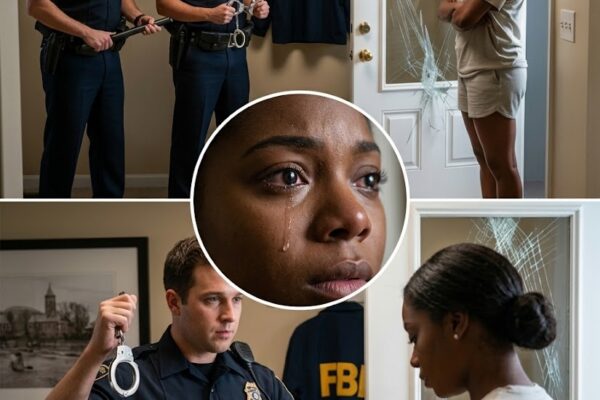
He holds up a small plastic bag. White residue inside. Drug paraphernalia. Plain sight. Grace’s eyes widen. That’s not mine. Sure it isn’t. Stevens looks confused. He searched everything, found nothing. Blake’s camera shifts, catches Pollson’s hand, the bag appearing from nowhere. Planted evidence. Blake sees it. Says nothing.
That is not mine. You planted that. Everyone saw you. I didn’t see anything. Pollson looks at Stevens. Did you? Stevens hesitates. No, sir. Officer Blake. Blake’s throat tightens. No, sir. Lie recorded on his own camera. The elderly woman across the street still films. I saw it. That came from his pocket. Pollson turns.
Stevens, secure that witness. Obstruction. Stevens crosses the street. The woman backs away. Grace steps forward. She’s exercising First Amendment rights. She’s interfering. Pollson grabs Grace’s wrists, pulls them back. Cuffs click tight. Too tight. You’re under arrest for possession. You have the right to remain silent.
He recites Miranda while tightening the cuffs. Deliberately painful. These are too tight. He ignores her, leads her to the patrol car, forces her head down, shoves her in. The elderly woman released with a warning. Phone confiscated evidence. She’ll never see it again. Witnesses disperse. Nobody wants involvement. Blake stands alone.
Stares at the scattered hair. His body cam recorded everything. What does he do? Police station. Fluorescent lights. Institutional walls. Grace processed. Fingerprinted. Photographed. The booking officer looks uncomfortable. She’s too calm. Doesn’t fit. Occupation. Federal employee. Be specific. I decline.
He types it. Moves on. Her mug shot shows everything. Bald head, scraped cheek, unbroken dignity. One phone call. She doesn’t call a lawyer. Calls her court clerk. Lisa, it’s Grace. I need bail posted. Call James Morrison. My attorney. Judge Hayes. Are you downtown precinct? Don’t alert anyone else. No media. Not yet.
What happened? I’ll explain. Just get James here. Break room. Pollson and Stevens drink coffee. Pson leans back. She’ll drop charges. They always do. Stevens doesn’t look convinced. She cited case law. She’s not ordinary. Doesn’t matter. Union handles it. We’re back on duty next week. You planted evidence. I secured evidence. Big difference. The cameras.
We’ll show what I need them to show. Door opens. Sergeant Brennan enters. 50s hard eyes. 25 years. You two, my office. She closes the door behind them. What happened out there? Pollson shrugs. Routine stop. Suspect combative. Found paraphernalia. That’s your story. That’s what happened. Brennan stares.
She knows, but proof is different. Clean up your reports. Make them match every detail. Yes, ma’am. Don’t talk to anyone. Not other officers, not your families, nobody. Understood. She dismisses them. Sits alone. This is bad. That woman knew too much. Didn’t break. But it’s too late. Reports filed. Arrest official. Protect the officers. That’s her job.
She picks up the phone. Calls the union rep. We might have a problem. Holding cell. Grace sits on metal bench. Eyes closed. Cataloging everything. Title 18, section 242, deprivation of rights. Title 18, section 1519, evidence tampering. 42 USC section 1983, civil rights lawsuit. The charges stack in her mind.
Her attorney arrives, James Morrison, 60, civil rights specialist. He sees her. His face pales. Grace, what did they do? What you see? We’re getting you out. Bail hearing quick. Judge signs release. Cash posted. 90 minutes after arrest. Grace walks free. Changed, scarred. James walks beside her. Tell me everything. Not here.
I need you to file a complaint with internal affairs, federal civil rights violation. Against who? Officer Derek Pollson, badge 4883. Officer Kyle Stevens, Officer William Blake as witness. Perfect recall, every detail. James understands. You’re building a case. I’m documenting truth. This will be public, messy. Your reputation is built on integrity.
Integrity demands justice. Not just for me, for everyone they’ve done this to. He nods. Then let’s go to war. She shakes her head. Not war, justice. There’s a difference. They walk to his car. Behind them, the police station stands like a fortress. Inside, Pollson celebrates. Outside, Grace plans. Officer Blake drives home. The SD card in his pocket feels like lead.
He parks, sits in darkness, stares at his hands. Those hands did nothing, said nothing, stopped nothing. He’s complicit now. The question is what he does next. Because that body cam footage is the key to everything, and only he knows it exists. Officer Blake drives home. City blurs past. autopilot. His apartment is dark.
He sits on the couch, doesn’t turn on lights, body cam on the coffee table. He should upload footage, file his report, move on, but his hands won’t move. 3:00 a.m. No sleep. He plugs the cam into his laptop. Watches from the beginning. Grace’s calm compliance, her refusal of consent, the search finding nothing, then the moment. Pulson’s back to camera, hand moving, bag appearing, Blake rewinds.
Frame by frame, clear as day, planted evidence, his own voice. No, sir. Lying on camera, he watches the Clippers, hair falling, her voice citing statutes while being degraded. Blake closes the laptop, hands shaking. 8 months on the force. This was his dream. Serve and protect. Instead, he watched a crime, did nothing, participated. Phone buzzes.
Stevens, don’t forget to upload cam footage. Sarge wants reports by 0800. Blake types back. We’ll do but doesn’t upload. Not yet. Morning station. Blake arrives early. Approaches Stevens in locker room. Casual testing about yesterday. That got intense. Stevens doesn’t look up. Pulson knows what he’s doing. The hair cutting.
Never seen that protocol. Stevens’s jaw tightens. You’ve been here 8 months. He’s been here 15 years. Maybe there’s protocols you haven’t learned. I just thought, don’t think. Back your partners. That’s the job. Message received. Blake tries Sergeant Brennan’s office. Knocks. Ma’am, about yesterday’s arrest. The suspect seemed compliant and that hair search technique. Her eyes go cold.
What about it? I wasn’t aware we had protocol for officer Blake. She stands, closes door. Pollson has 15 years exemplary service. You have 8 months. Are you questioning his judgment? No ma’am. Just want to understand. Then understand this. We protect our own. When an officer makes field decisions, we support them. We don’t second guessess.
We don’t create problems. Clear? Yes, ma’am. Have you filed your report? Working on it. Make sure it supports your fellow officers. That’s what being part of this department means. He leaves. Message unmistakable. Corruption goes up the chain. Blake sits at his desk, opens report form. Cursor blinks. Truth or lie? He researches instead.
Pulls arrest record. Grace Hayes. No priors. Clean. federal employee. He digs deeper. Public records. Then finds it. Confirmation hearing 3 months ago. Federal circuit court. Judge Grace Hayes, newly appointed civil rights specialist, constitutional law expert. Blake’s blood runs cold. Pulls up her photo.
Long hair, professional, confident. Same woman. The woman Pollson shaved bald on a public street. They didn’t assault a citizen. They assaulted a federal judge. He opens his drawer, pulls blank SD card, looks around, bullpen busy, nobody watching, copies his footage, complete, unedited, everything. Then edits a second version. Removes clearest angle of the plant.
Keeps everything else. Still shows excessive force. Hair cutting, but not clear enough to prove the plant definitively. This version he uploads to department server. Original stays in his pocket playing both sides cowardly, but all he can manage. Phone buzzes. Unknown number. You recorded everything. Keep that footage safe. You’ll need it.
Blake stares. Who sent this? How do they know? He deletes the message, but someone knows. Someone is watching. Attorney James Morrison’s office. Grace sits across from him. Head wrap covering scalp. Composed. Filed a complaint with internal affairs. Named all three officers. Included your statement. Medical documentation. Good.
This will get ugly. They’ll investigate you. Look for anything to discredit. Let them look. My record is clean. They’ll argue you provoked them. Citing law was intimidation. Knowing my rights isn’t provocation. James nods. Also notified the chief judge. You’re entitled to medical leave. 6 to 8 weeks. I’ll take it.
Want this resolved before returning to bench. Something else. Reached out to DA’s office. Off record. They’re interested. Very interested. Criminal charges. Potentially federal civil rights violations. If they can build strong enough case, they can. I’ll testify, provide everything. James hesitates. You’re the victim and potentially the judge if this ends up in federal court through random assignment.
That’s complicated. I’ll handle it ethically. Full disclosure. Opportunity for recusal. If they don’t recuse me, I preside. You sure? She touches her head wrap. I’m sure. Internal affairs office. Lieutenant Davis opens new file. Complaint against Pollson Stevens. Blake reads Grace’s statement. Eyebrows rise.
Federal judge. Constitutional violations. Planted evidence allegations. Career ending serious. He escalates. Calls Chief of Police. Chief, we have a situation. Excessive force complaint. Possible evidence tampering. Who’s the complainant? Federal Circuit Court Judge Grace Hayes. Silence. You’re sure? Confirmed her identity. It’s her.
Jesus Christ. Chief exhales. Start full investigation. Quiet. No leaks. Davis calls Pollson in. Separate interview. Pollson sits relaxed, confident. Been through IIA before, always walks clean. Walk me through the downtown traffic. Stop Tuesday afternoon. Routine stop. Erratic driving. Subject became combative when questioned.
Define combative. Verbally aggressive. Started citing laws to intimidate me. Is it intimidation when citizens know rights? It is when they use it to obstruct lawful investigation. What probable cause for search? Furtive movements. Hands below window line. Suspicious behavior and the hair search. Contraband concealment protocol.
Found drugs hidden in hair before. Who taught this protocol? Years of experience. Street knowledge. Davis makes notes. Doesn’t challenge. Builds record. Stevens’s interview. Similar. Backs. Pollson completely. Consistent story. Blake is last. Enters nervous. Sweating. You were third on scene. Yes, sir. What did you observe? Blake chooses words carefully.
Stop. Already in progress. I observed officer Pollson conducting search. Subject cooperative but verbally assertive about rights. Did you witness the hair cutting? Yes, sir. And discovery of drug paraphernalia? Pause. Too long. Yes, sir. Where exactly was it found? Near the subject’s belongings on sidewalk.
Did you see Pollson find it? Another pause. I saw him secure it as evidence. Davis leans forward. That’s not what I asked. Blake’s throat tightens. I saw him pick it up. Yes. From where? From the ground. Near her things. Lie documented on interview recording. Davis dismisses him. Makes notes. Three officers. Consistent stories.
United Front against one complainant. No matter how credible. But Davis has done this 20 years. He knows when officers lie. The pauses, careful wording, rehearsed quality. He picks up phone. Calls DA’s office. Lieutenant Davis, internal affairs. Sending you a case file. Federal civil rights violation. You’ll want to see this. Blake’s phone buzzes.
Same unknown number. Trust the process. Justice is coming. He deletes it. Doesn’t forget because someone knows everything and they’re not staying quiet. Across town, Grace sits in her apartment, looks at herself in the mirror, head wrap covering bare scalp. She’s not the same woman who drove downtown 3 days ago. She’s angrier, focused, determined.
Officer Pollson wanted to teach her a lesson, to humiliate her, to remind her of her place. He succeeded in one thing. He made an enemy of the one person who has power to destroy him legally. And she will. Through the system, through law, through justice, not revenge, justice. There’s a difference.
And she’s about to teach him what it is. Four weeks pass. District Attorney Amanda Williams reviews the case. Civil rights specialist, 15 years experience. She reads the file, watches Blake’s edited footage, interviews witnesses, the elderly woman, the businessman. Both give statements. The businessman’s video still exists. Shows everything.
Williams requests forensic analysis on the drug bag. Fingerprints, DNA. Results return. Pollson’s prints. Clear. Not graces. Planted evidence confirmed. Williams takes it to grand jury. Secret proceedings. No leaks. Grand jury hears testimony. Sees footage. Reviews evidence. Two hours deliberation. Indictments returned.
Officer Derek Pollson. Officer Kyle Stevens. Criminal civil rights violations. Title 18, section 242. Assault under color of law. False arrest. Evidence tampering. Sergeant Linda Brennan. Obstruction. Conspiracy. Arrest warrants issued. Police station morning. Federal marshals arrive. Pollson and Stevens arrested at their desks. Handcuffed.
Perw walk past fellow officers. Suspended without pay. Trial pending. Union provides attorney. Ronald Mitchell, 60. Defended dozens of officers. won most. He meets with clients, conference room, confident. This will blow over. Federal judges are pro law enforcement. We’ll argue qualified immunity, reasonable mistakes, no criminal intent. Pollson nods.
When’s trial? 8 weeks. Federal court. Random judge assignment. And the judge? We’ll find out. But federal judges understand police work. They give officers benefit of doubt. Stevens looks uncertain. What about footage? Witnesses? We argue she was combative. You followed protocol. Force was reasonable. The drug bag.
Mitchell waves dismissively. Your word against hers. Juries don’t convict officers on he said. She said, but Mitchell hasn’t seen forensic report yet. Doesn’t know what Williams has waiting. Trial date set. Judge assignment posted. USA. Pollson and Stevens. Presiding honorable G. Hayes. Federal Circuit Court.
Name means nothing to Mitchell. Nothing to Pollson or Stevens. Just another federal judge. probably older, conservative, pro cop. They don’t research. Blake sees the assignment. Blood freezes. G. Hayes. He Googles. Confirmation hearing. Biography. Photo. Judge Grace Hayes. Civil rights expert. Recently confirmed. Photo loads. Long hair. Professional.
Confident. His coffee cup drops. Shatters. It’s her. The woman from the stop whose head Pulson shaved. Who he watched being degraded. She’s their judge. Blake’s hands shake. He texts the unknown number. I know who you are. Immediate response. Then you know what to do. Bring the original footage. The trial needs it.
How do they know about the original? Another message. Your conscience has been fighting you 4 weeks. Time to listen. Blake stares at his badge on the table. His reflection. Who is he? Someone who watches crimes and stays silent or someone with courage to tell truth? He decides. Messages back. I’ll be there. Grace’s apartment. Evening.
She reviews case files, preparing to return to bench. Hair growing back, short, uneven. Still wears head wrap. By choice now. Her armor, her symbol, calendar alert, trial date. 6 weeks away. She touches the head wrap. Remembers the concrete, the clippers, the humiliation, and thinks about the courtroom, the bench, the power to ensure this never happens again.
James calls. Judge assignment came through. Random selection. And it’s you. Silence. Grace. I’m here. Are you recusing? She considers. Could step aside, let another judge handle it. Avoid complications. But she remembers Pollson’s smile. His certainty he’d get away with it. No, I’ll disclose everything.
Give them opportunity. But if they don’t request recusal, I preside. You’re sure? Never been more sure. 6 weeks until trial. 6 weeks until Pollson walks into her courtroom. 6 weeks until justice. The countdown begins. 3 weeks before trial. Pre-trial hearing, federal courthouse, smaller courtroom, wood panled, substitute judge presiding, not grace.
She recused from pre-trial to avoid bias. Defense attorney Mitchell files motions, suppress evidence, dismiss charges, change venue. Prosecutor Williams opposes all. Judge calls officer William Blake. Blake enters, uniform pressed, face pale, trembling. Mitchell stands. Officer Blake, how long on the force? 8 months, sir.
Pollson has 15 years. You deferred to his judgment initially. What changed? What I saw? Mitchell smirks. You’re a rookie who doesn’t understand police work. Blake looks at him. I understand the Constitution. I saw what happened. I know the difference between police work and crime. Murmurss ripple. Smirk fades. You submitted body cam footage? Yes.
Shows everything. Throat dry. Most. Most. I edited what I submitted. Silence. Why? Voice cracks. Fear. Retaliation. Losing my career. I kept the original. Submitted. Edited version. Mitchell attacks. You tampered with evidence. I was a coward initially, but I kept the original. Everything unedited. William stands.
Officer Blake came forward with complete footage. We have it. Entering now. Mitchell objects. Chain of custody broken. He preserved it separately. Metadata confirms authentic. Timestamps match. Judge considers. Allowed. Play it. Screen lowers. Lights dim. Footage plays. Pollson’s voice. You think you’re better than me? Slam.
Grace’s face hits Hood. Her voice. I do not consent. Search finds nothing. Crucial moment. Pollson’s back to camera. Hand to pocket. Bag appears. Clear. Planted evidence. Clippers buzzing. Hair falling. His satisfaction. Her dignity. Everything documented. Silence. Mitchell has no response. Blake sits crying. I should have stopped it.
Called it in. I didn’t. I was scared. I’m sorry. I can’t stay silent anymore. This is truth. Relief beat. Truth spoken. Blake redeemed. Judge reviews. Motions denied. Evidence stands. Trial proceeds. Mitchell slumps. Pollson and Stevens whisper frantically outside. Media swarms Blake. Why come forward? Blake faces cameras.
Because it was wrong. I witnessed crime. Did nothing. That makes me complicit. But I tell truth now. Concerned about retaliation. more concerned about living with myself. Bad should protect people, not hurt them. Walks away. Conference room. Mitchell meets clients. Panic evident. Can we settle? Pollson, desperate. No. Federal charges don’t settle.
You go to trial. Steven shakes. Our chances after that footage. Bad. Very bad. But something else. Opens laptop. Types. The judge. G. Hayes. Photo loads. Article. Federal judge confirmed. Grace Hayes, civil rights expert, long hair, professional, confident. Mitchell goes white. This is her. Pollson stares pale. Impossible. Not impossible.
You attacked a federal judge. She presides over your trial. Stevens head in hands. Finished. Filing emergency recusal motion. She can’t judge where she’s victim. Will it work? Don’t know. Only shot we have. Two weeks away. Defense realized the trap. Woman holding it wears judicial robes. Trial day arrives.
Federal courthouse packed. Media everywhere. Activists holding signs. Police union representatives filling gallery. Defense filed emergency recusal motion yesterday. Denied by Chief Judge. Grace has discretion to preside if she chooses. Courtroom buzzes with anticipation. Everyone knows something historic is about to happen.
Pollson and Stevens sit at defendant table. Cheap suits, nervous energy. Their attorney Mitchell looks defeated already. Baleiff stands. Voice cuts through noise. All rise. Everyone stands. Rustling fabric scraping chairs held breath. The honorable judge Grace Hayes presiding. Door behind bench opens. Grace enters. Judicial robes flow as she walks.
Her head covered with elegant gold silk head wrap wrapped with precision. Regal powerful. She moves with quiet authority. Takes her position at bench. Arranges papers methodically. Adjust microphone. Doesn’t look up yet. Pollson’s face drains completely of color. All blood rushes from cheeks. His mouth opens. No sound comes.
Stevens grabs table edge, knuckles white. He leans toward Mitchell, whispers something urgent. Panicked, Mitchell nods grimly. He already knows. Grace lifts her head. Her eyes scan the courtroom. Professional, measured, takes in prosecution table, the gallery, jury box. Then her gaze lands on defendant table, on officer Pollson, on officer Stevens.
She holds their stare for exactly 3 seconds. Her expression doesn’t change. Not a flicker of emotion, just cold judicial authority. Pollson tries to stand. Mitchell yanks him down hard. Stevens’s breathing becomes audible. Short, rapid, trapped animal. Grace’s voice fills the courtroom. Calm, clear, powerful. The United States of America versus Derek Pollson and Kyle Stevens.
Criminal civil rights violations under Title 18, Section 242. Assault under color of law. False arrest, evidence tampering. She pauses, lets charges hang in air. Before we proceed, I want to address the recusal motion filed by defense. I am fully aware that I am the alleged victim in this case. I have disclosed this fact completely.
You’ve had two weeks to prepare. Mitchell stands shakily. Your honor, with respect, how can you possibly be impartial when counselor? Her voice cuts like blade. I’ve presided over cases involving defendants who threatened my life. I’ve ruled against my own preferences countless times. I follow law, not feelings. I am capable of impartiality. That’s what judges do.
But your honor, I’m giving you opportunity now. Request recusal formally in front of this court. I’ll refer it to chief judge for final determination. Mitchell looks at his clients. They whisper frantically, trapped. Requesting recusal admits she’s the victim, confirms everything, makes them look guilty.
Not requesting means she judges them. Either way, they lose. Mitchell sits slowly. We’ll proceed, your honor. Very well. Grace opens first folder. Let’s begin with evidence. Prosecutor Williams, you may call your first witness. Pollson’s hands shake on the table. Can’t control them. The reckoning has begun. Prosecutor Williams stands.
Your honor, the United States calls its first witness, Officer William Blake. Blake enters full dress uniform, walks to stand, gets sworn in. Williams approaches. Officer Blake, you were third on scene that afternoon, correct? Yes, ma’am. What did you observe? Blake takes breath. I observed Officer Pollson conducting what appeared to be a traffic stop.
The subject was compliant, cooperative, but verbally assertive about her constitutional rights. And then, Officer Pollson became increasingly aggressive. He ordered a hair search using electric clippers. Is that standard protocol? No, ma’am. There is no such protocol. What happened next? He shaved her head completely on the public street in front of witnesses.
Williams nods and the drug paraphernalia found at seen. Blake’s voice steady. I witnessed Officer Pollson plant that evidence. He removed it from his own pocket, placed it near her belongings, then claimed to discover it. Courtroom erupts. Grace gavvels for order. Mitchell jumps up. Objection. Witness is biased against his fellow officers.
Overruled. He’s testifying under oath. Continue, prosecutor Williams. Williams pulls out remote. Let’s watch the evidence, your honor. Entering states exhibit 1. Traffic camera footage. Screen descends. Lights dim. Traffic camera footage plays. Shows Grace’s car driving normally. Speed visible in corner. 32 mph. Limit is 35.
No erratic driving. No violation. clean. As you can see, there was no legitimate reason for the traffic stop. Mitchell objects weakly. Traffic stops don’t require the Fourth Amendment requires reasonable suspicion. There was none overruled, Williams continues. States exhibit 2 bystander cell phone video. New footage plays shaky but clear audio shows Paulson forcing Grace down, her voice clear. I do not consent.
I do not consent. The clippers hair falling. Children watching. Mother pulling child away. Jurors shift uncomfortably. Some lean forward, riveted. Williams pauses video. Notice the subject’s repeated refusal of consent. She knew her rights. She exercised them. That angered Officer Pollson. Mitchell stands. Objection.
Speculation about my client’s emotional state. Sustained. Stick to evidence. Counselor. Williams nods. States exhibit 3. Officer Blake’s complete body cam footage unedited. This is the big one. The smoking gun. Footage plays from Blake’s perspective. Shows everything. Grace’s calm compliance. The baseless search, finding nothing.
Then Pollson’s back partially blocks camera, but enough visible. His hand goes to his pocket, pulls out small plastic bag, drops it near Grace’s belongings, turns around. Well, well, look what we have here. Crystal clear. Undeniable planted evidence. Gasps throughout courtroom. One juror’s mouth drops open. Stevens puts his head in his hands.
Williams lets moment sink in. Ladies and gentlemen of the jury, you just watched a sworn police officer commit a felony on camera. Mitchell objects. Your honor, that’s argument sustained. Save it for closing. Counselor Williams. Williams switches gears. States exhibit 4. Audio recording from victim’s phone. Audio plays high quality. Grace’s voice.
Officer Pollson, badge number 4883. I do not consent. This violates my Fourth Amendment rights. Title 18, section 242. You are committing assault under color of law. Pollson’s voice. You think you’re smart? Think you’re somebody? Sound of clippers. Her silence. His taunts. You’re about to learn respect. Now you look like what you are.
The recording stops. Silence in courtroom. Williams addresses jury. She cited the exact federal statute. Title 18 section 242. The same statute these defendants are charged under. She knew the law. That’s what made her dangerous to them. Moves to next phase. The United States calls Dr. Sarah Mitchell, forensic specialist. Dr. Mitchell takes stand.
Expert credentials established. Williams holds up evidence bag. Doctor, you analyze this plastic bag found at scene. Yes. What did you find? I found fingerprints. Clear prints on the exterior of the bag. Whose prints? Officer Derek Pollson’s. His prints were on the bag. The victim’s prints were not.
Pson shifts in seat, whispers urgently to attorney. What does that indicate? That officer Pollson handled this item. The victim did not. Is it possible she touched it but left no prints? Highly unlikely. The plastic surface readily captures Prince. If she’d handled it at all, there would be evidence. Thank you, doctor. Cross-examination is brief.
Mitchell has nothing. Can’t dispute science. Williams continues building. The United States calls Dr. Raymond Anderson, psychologist. Dr. Anderson takes stand, reviews Grace’s medical records. Doctor, you evaluated the victim 3 days after incident. Yes. She exhibited signs of acute psychological trauma, humiliation, violation of dignity, public degradation.
Can you describe the physical evidence? Her scalp showed irritation from the clippers, small cuts, abrasions, evidence of forceful, careless use, long-term effects. She reported nightmares, anxiety in public spaces, hypervigilance around police, classic PTSD symptoms from abuse of authority. Mitchell doesn’t cross-examine, can’t dispute trauma.
Williams pivots. The United States calls Lieutenant Davis internal affairs. Davis takes stand, brings thick file. Lieutenant, how many prior complaints were filed against Officer Pollson? Three formal complaints in the past four years. Nature of complaints. All involved excessive force. Two involved female suspects.
One involved racially charged language. What happened to those complaints? Two were settled quietly by the city. Monetary payouts to victims. One was dismissed due to lack of evidence. So, Officer Pollson had a pattern. Mitchell objects. Relevance, your honor. Goes to pattern and intent. Overruled. Davis continues. Yes. a pattern of aggressive behavior towards citizens who asserted their rights.
And Sergeant Brennan, she supervised officer Pollson. Multiple complaints crossed her desk. She consistently defended him, blocked investigations. Thank you, Lieutenant. Williams looks at jury. Pattern of abuse, pattern of cover up, pattern of believing they were above the law. Now the crescendo, the moment everyone’s waiting for.
The United States calls the victim. Judge Grace Hayes. Grace stands, removes her judicial robe, walks to witness stand, gets sworn in. The symbolism is powerful. The judge becomes witness in her own trial. She sits composed, handsfolded. Williams approaches gently. Judge Hayes, can you tell the jury what happened that afternoon? Grace speaks clearly, factually.
No emotion, just truth. I was driving home from visiting my mother. I was stopped without cause. I complied with all requests. I asserted my Fourth Amendment rights verbally and clearly. I was subjected to an illegal search. When nothing was found, Officer Pollson became angry. He used electric clippers to shave my head on a public street in front of witnesses, including children. It was deliberate humiliation.
Then he planted evidence and arrested me. How did you feel? Violated, degraded, humiliated, but also determined. Determined that this would not stand, that accountability would happen. Mitchell stands for cross-examination. nervous. Judge Hayes, you cited case law during the stop. You used legal terminology.
Were you trying to intimidate officer Pollson? Grace looks at him steadily. Counselor, I’m a federal judge. I’ve spent my entire career studying constitutional law. When my rights were violated, I identified the violations clearly. Knowing your rights is not intimidation. It’s citizenship. But you never identified yourself as a judge.
I was off duty on personal time. I have no obligation to identify my profession during a traffic stop. And frankly, it shouldn’t matter. The Constitution protects everyone equally, whether they’re a judge or a janitor. Applause starts in gallery. Grace gavels it down herself from witness stand. Order. Mitchell tries again.
Your honor, Judge Hayes, how can you be impartial in this case? I’m not judging from this chair, counselor. I’m testifying. When I return to that bench, I’ll judge based on evidence and law, nothing else. But surely your personal experience, my personal experience makes me understand exactly what happened. It doesn’t prevent me from being fair.
In fact, it ensures I’ll be scrupulously fair because the entire legal community is watching. Mitchell has nothing left. Sits, then it happens. The shock beat. Grace stands. Her hands go to her head wrap. She unwraps it slowly, deliberately. Her scalp is visible. Hair has grown back in patches. Uneven, scarred where clippers cut too deep.
Still healing. She turns slowly. Shows the jury. Shows the gallery. Shows Pollson and Stevens. This is what standard procedure looks like when power becomes weapon. Gasps throughout courtroom. One juror wipes eyes. Grace rewraps her head. Returns to bench. Puts on her robe. The transformation is complete. Victim to judge.
Powerless to powerful. Williams addresses jury. Ladies and gentlemen, you’ve seen video evidence, audio evidence, forensic evidence, medical evidence, pattern evidence, testimony from fellow officer, and testimony from the victim herself. The evidence is overwhelming. These defendants violated their oaths. They violated the constitution.
They violated a human being. They must be held accountable. Grace looks at Pollson. Counselor Mitchell, does defense wish to call witnesses? Mitchell looks at his clients. They shake heads. What can they say? Everything is on camera. No, your honor, defense rests. Very well. Closing arguments tomorrow morning. We’re adjourned. Gavl strikes.
Pollson stares at his hands. The hands that held those clippers. The hands that planted evidence. The hands that destroyed a woman’s dignity. Now those hands shake. Powerless. Stevens whispers. We’re done. Completely done. Outside. Media frenzy. But inside courtrooms, silence. Justice isn’t loud. It’s thorough. It’s evidence.
It’s truth stacked layer upon layer until denial is impossible. Tomorrow, closing arguments, then jury deliberation, then verdict. But everyone in that courtroom already knows. They saw it. All of it. The only question now is the sentence. Next morning, closing arguments brief. Evidence speaks for itself. William summarizes, “These defendants saw a black woman who knew her rights, who spoke clearly, who challenged their authority, and they punished her for it.
They weaponized their badges. They violated the Constitution. They must face consequences.” Mitchell tries. “Officers make difficult decisions under pressure. They deserve benefit of doubt.” But the jury saw the footage, heard the audio, saw the victim’s scarred scalp. Grace instructs jury. You must determine if these officers willfully violated constitutional rights.
Willfully means intentionally. Did they know what they were doing was wrong? Jury deliberates. 4 hours. They return. Foreman stands. Older black woman, retired teacher, holds verdict form. In the case of United States versus Derek Pollson, count one, deprivation of rights under color of law. How do you find guilty? Pollson’s head drops.
Count two, assault under color of law. Guilty. Count three, false arrest. Guilty. Count four, evidence tampering. Guilty. Steven<unk>’s verdict identical. Guilty on all counts. Courtroom silent. Then quiet sobbing from gallery. The woman who filmed. Finally believed. Finally, justice. Grace gavvels gently. Sentencing scheduled for 30 days.
Defendants remanded to custody. Federal marshals approach. Handcuffs click. Pollson and Stevens led away. The men who abused authority now stripped of freedom. 30 days later. Sentencing hearing. Courtroom packed media activists police union representatives community members Pollson and Stevens in prison jumpsuits orange humiliating Grace enters takes bench I’ve reviewed pre-sentencing reports victim impact statements federal sentencing guidelines everything submitted by both sides she looks at defendants Mr. Pollson Mr.
Stevens, you violated your oaths. You weaponized authority against a citizen exercising constitutional rights. You saw assertiveness as threat, knowledge as challenge. Victim impact statements read aloud. The two other women who testified, similar stories, similar abuse. Your pattern went unchecked because the system protected you.
Fellow officers stayed silent. Supervisors covered for you. Mitchell pleads for leniency. Officer Pollson has 15 years of service. Commendations: family. Officer Stevens has young children. Please consider. I’ve considered everything, counselor. I’ve also considered the families these officers terrorized.
Citizens who lost faith in law enforcement. Damage to public trust. Grace pauses. Here’s what the law requires and what justice demands. Derek Pollson. Four years in federal prison, three years supervised release, permanent loss of law enforcement certification in all 50 states. You will never wear a badge again. Pollson slumps. His wife sobs.
Kyle Stevens. 2 years in federal prison, 3 years supervised release. Permanent loss of certification. Stevens closes his eyes. Tears stream. Sergeant Linda Brennan in separate proceeding received 18 months for obstruction. forced retirement, pension reduced. You3 didn’t just violate one person. You violated public trust.
The badge means service, protection, integrity. You turned it into a weapon. This court recognizes most police officers serve honorably. They protect communities, risk their lives daily. But when officers abuse power, they undermine every good cop. They make policing more dangerous for everyone. She looks directly at them.
You’ll have time to reflect on what you stole from me, from others, from the badge you wore. Court is adjourned. Gavl falls. Final marshals lead them away to federal prison to years of consequences. Outside courthouse, media surrounds Williams. This verdict sends a message. Badge doesn’t grant immunity. Constitution applies to everyone.
Blake stands nearby. Civilian clothes now. He resigned last week. Reporter approaches. Officer Blake, what’s next? I’m working with a civil rights organization, training officers on constitutional policing, on speaking up when they see abuse, on courage over comfort. Any regrets? Only that I didn’t act sooner. But I can’t change the past.
I can only impact the future. 3 months later, civil lawsuit settled. City pays substantial damages, undisclosed amount, reported seven figures. Department implements reforms. Body cameras mandatory. No discretion to turn off. Outside review board, deescalation training, community oversight. Will it prevent all abuse? No, but it’s progress.
6 months later, different trial. Routine hearing. Grace presides. Still wears head wrap daily. Not from necessity. Hair is grown back, but head wrap is signature now. Symbol of dignity reclaimed. Young black woman attorney appears. First time. Nervous. Handles case well. After hearing, she approaches bench. Judge Hayes.
Seeing you here matters. What you did matters. Thank you. Grace smiles. The law belongs to everyone. Make sure it stays that way. I will, your honor. She leaves inspired. Evening. Grace’s chambers. Reviews tomorrow’s docket. Standard cases, constitutional questions, civil rights disputes. This is the work. Not dramatic trials. Not viral moments.
Just daily grinding effort. Her clerk, Lisa Knox. Judge. The officer’s appeal was denied. Convictions upheld. Grace nods. Good. Appeal was expected, but evidence was overwhelming. No grounds for reversal. On her desk sits framed photo. Her confirmation hairong smiling. She looks at her reflection now. Head wrap golden lamplight. Changed stronger.
Officer Pollson wanted to teach her a lesson about power, about place. He succeeded, but not the lesson he intended. She learned that dignity can be assaulted but never destroyed. that systems bend toward justice when individuals demand it. That courage inspires courage. She learned real power isn’t domination. It’s service.
Using authority to lift rather than crush. She returns to her work. Case files, motions, legal briefs. Tomorrow, another hearing, another case, another opportunity to ensure the Constitution protects everyone equally. Justice isn’t a single moment, not one verdict or sentence. It’s daily work. unglamorous, essential, persistent.
It’s Blake training new officers, Williams prosecuting abuse, community members reporting violations without fear, judges ruling fairly despite personal cost. It’s the system repairing itself slowly, one case at a time. Grace closes her files. Tomorrow starts early. Officer Pollson tried to make her small, powerless, broken.
Instead, he made her legendary. And more importantly, he made the system slightly better for everyone who comes after. That’s not revenge. That’s justice.