“Play This Song and I’ll Marry You” — Billionaire Mocks a Black Server Until One Note Stuns the Room
“Play This Song and I’ll Marry You” — Billionaire Mocks a Black Server Until One Note Stuns the Room 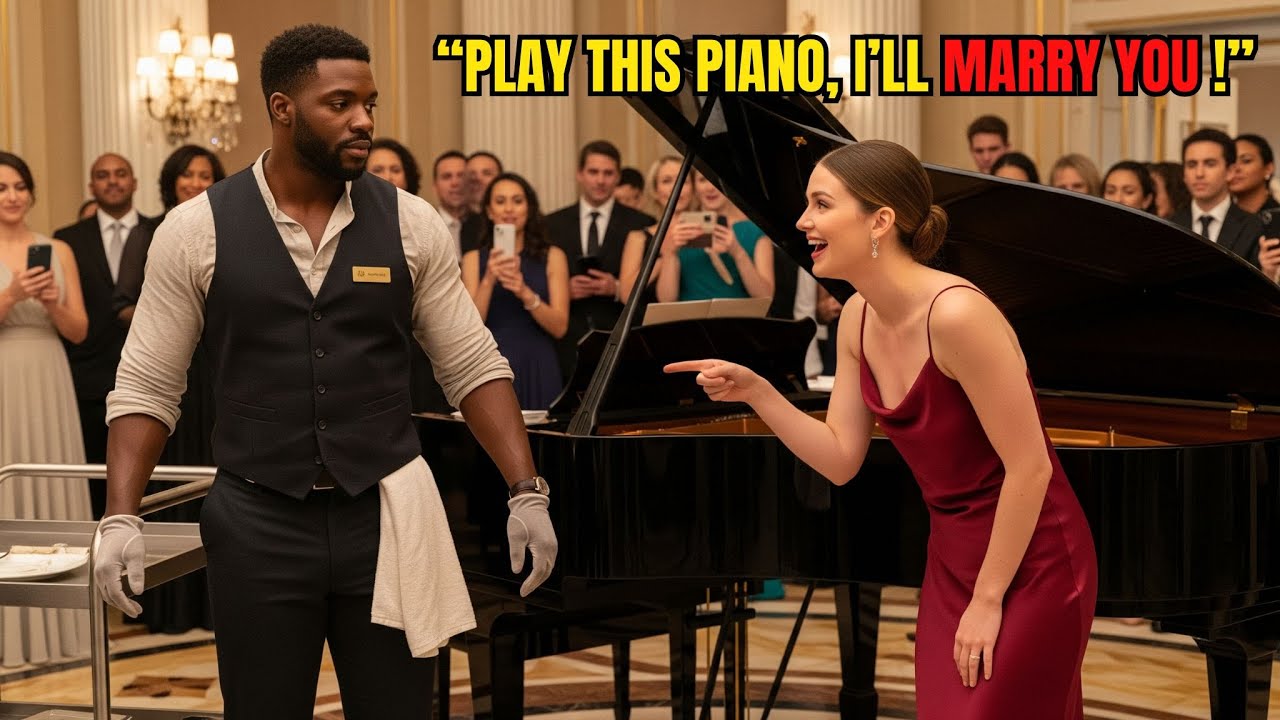
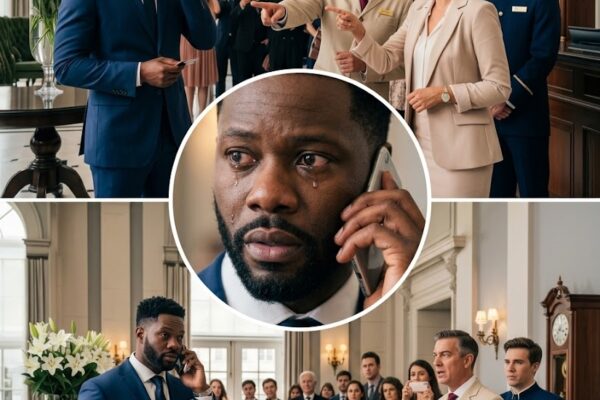
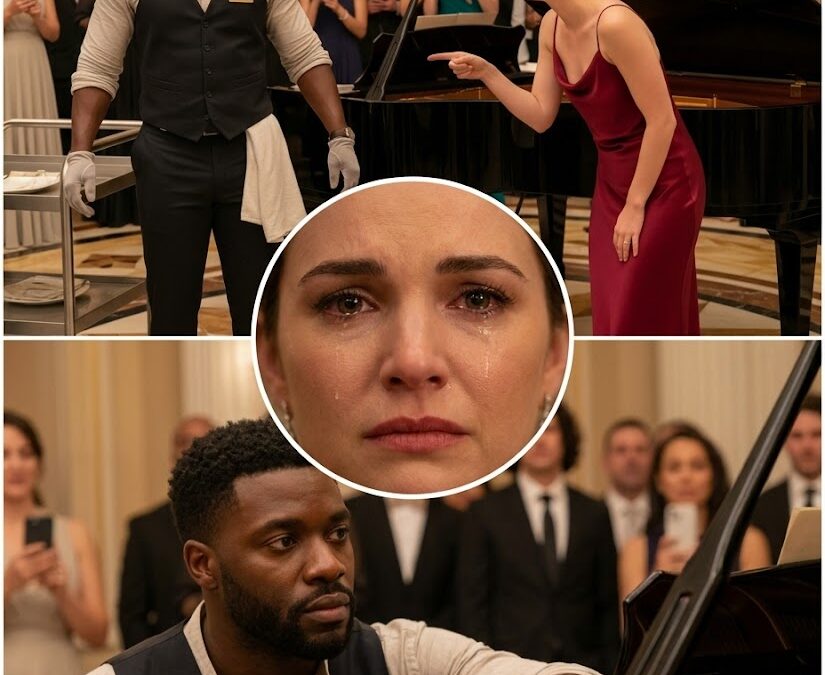
A black waiter playing debusy. That’s adorable. Like watching a dog walk on its hind legs. You don’t expect it to be good. You’re just surprised it can do it at all. Victoria Sterling’s laughter cuts through La Symphony. 50 witnesses. Cameras already recording. Miles Brooks, black server, 28, minimum wage, stands there holding a tray of dirty dishes.
She snaps her fingers like calling a dog. Play Claire DeLoon perfectly, sweetie, and I’ll marry you. $1 million cash tonight. Her table erupts in laughter. The room watches, waiting for him to run. Miles stares at the white grand piano in the center of the room. Untouched, decorative, impossible. 28 years of people like you.
28 years of being invisible. 28 years of this exact moment. Have you ever stood at the edge of something that could destroy you or save you? What happened in the next 3 minutes changed everything? 42 floors above Manhattan, La Sanonyi exists in a different world. Floor to ceiling windows frame the city like a painting.
Crystal chandeliers refract light into a thousand diamonds. White tablecloths stretch across 50 tables. Each one pristine, untouched, perfect. The air smells like truffle oil and old money. Like a place where a single entree costs more than Miles makes in a week. The grand piano sits in the center of the room.
Steinway white lacquer worth more than Miles will earn in 5 years. Nobody plays it. It’s decor, a conversation piece, something beautiful that exists to be looked at, not used. Miles has walked past that piano 200 times in 6 months. Never touched it, never been invited to. He’s not here to make music. He’s here to carry plates.
Tonight, the Friday dinner rush hums with quiet wealth. Conversations float in cultivated tones. Stock portfolios, vacation homes in Aspen, which private school for little McKenzie. Silverware clinks against bone china. Wine glasses catch the light. Everything moves with the choreography of money that never has to think about itself.
Miles weaves between tables in his black vest and white gloves. Invisible. That’s the job. Bring the food. Remove the plates. Smile when spoken to. Disappear when not needed. 6 months of this. Six months of yes ma’am and right away sir and eyes that look through him like he’s made of glass. The pay is $15 an hour. With tips, he clears 2,800 a month after taxes.
500 goes to his mother in Georgia. Diabetes medication, doctor visits, a broken health care system that doesn’t care. 1,400 for rent on a studio apartment in South Bronx. 300 for food. 200 for the subway. The rest disappears into the black hole of just surviving in New York City. 3 months. That’s what he has left.
His landlord already sent the letter. Rents going up to $1850 in January. Miles did the math three times hoping it would change. It didn’t. He’s $600 short every month. $600 he doesn’t have. 3 months until he has to leave. 3 months until he goes back to Georgia. 3 months until he gives up on the last shred of the dream that brought him here.
New York was supposed to be temporary. A place to regroup, to save money, to find a way back. 7 years later, he’s still here. Still carrying plates. Still invisible. Still so far from where he was supposed to be. Atlanta feels like a different lifetime now. The church where his grandmother played organ every Sunday. Her hands moving across the keys like birds in flight.
She taught him young, 6 years old, barely tall enough to reach the pedals. Baby boy, God gave you these hands for a reason. Don’t you ever hide them. He didn’t plan to. The high school music teacher, Mr. Patterson, heard him play at a holiday concert. Pulled him aside after. Son, you’ve got something. Real talent.
Not just good for your age, good, period. helped him apply to colleges, scholarships, a future that seemed impossible for a black kid from the south side of Atlanta. Berkeley College of Music accepted him at 19. Partial scholarship, enough to make it possible, not enough to make it easy. He worked two jobs that first year, campus cafeteria in the morning, Starbucks at night. Slept 4 hours, practiced six.
Professor Martinez said he played like someone who’d lived three lifetimes. You don’t just hit notes, Miles. You tell truth with them. Don’t ever lose that. Second year started strong. Lead piano in the fall concert. Professors talking about Giuliard for graduate school. About a career.
About a life doing the only thing he’d ever wanted to do. Then his father collapsed at work. Heart attack. Died before the ambulance arrived. Miles got the call at 2:00 in the morning. His mother’s voice breaking on the other end. Baby, I need you to come home. His little sister was 16. Someone had to help. Someone had to work. His mother couldn’t do it alone.
Not with her health, not with the bills, not with everything falling apart. Miles withdrew from Berkeley 3 weeks into the spring semester. Packed his life into two suitcases. Told Professor Martinez he’d be back. Just a year, maybe two, just until things stabilize. That was 9 years ago.
His sister graduated high school, got a job, moved to Tennessee. His mother’s health got worse, not better. The bills never stopped. And somewhere in the chaos of just surviving, the dream of going back got smaller and smaller until it lived in a place he tried not to look at too often. But the music never left. It couldn’t. It lived in his bones, in the rhythm of his heartbeat, in the way his fingers tapped patterns on tables when he thought no one was looking.
in the notebook he carries in his back pocket filled with melodies he hears in the subway in car horns in the way rain sounds different depending on what it hits every morning before his shift Miles stops at 59th Street Station there’s an old upright piano there some public art project free for anyone to play sits down for 30 minutes no one pays attention commuters rush past sometimes someone drops a dollar in a cup he doesn’t put out he’s not playing for money.
He’s playing to remember that his hands still know how, that 6 years away from a real piano hasn’t erased what’s written in his muscle memory, that he’s still a musician, even if no one can see it. Tonight started like every other night. Clock in at 5, check the reservation list, 50 covers, three private parties, brace himself for the usual invisible degradation of being the help in a world of people who’ve never had to help themselves.
He noticed the VIP table immediately. Table 12, corner position, overlooking Central Park, reserved for Victoria Sterling. He’d heard the name before, seen her face in magazines at the bodega. Fashion mogul, billionaire, the kind of person who exists in an atmosphere normal people can’t breathe. He served her table four times before the incident.
Each time a small cut. A little slow, aren’t we? Careful, darling. This bottle costs more than your rent. Do you people not get training? You people. Miles has heard those words his entire life. You people. People like you. You’re kind. Each phrase a polite way of saying what they’re really thinking. A way to other him without using the words they can’t say in public anymore.
He’s 28 years old. He swallowed those words for 28 years. Let them land. Let them sit. Let them rot inside him. Because fighting back means losing the job. And losing the job means losing everything else. Tonight, he stood at the edge of the kitchen waiting for appetizers for table 12, listening to laughter from the VIP section that sounded like breaking glass.
He didn’t know that in 10 minutes, everything would change. He didn’t know that Victoria Sterling was about to make the biggest mistake of her life. He didn’t know that the white piano in the center of the room was about to become a battleground. All he knew was that his hands were tired. His feet hurt. His soul felt heavy with the weight of being invisible.
But something was coming. Something he couldn’t name yet. Something that lived in the space between who he was and who he used to be. Between silence and sound. Between swallowing words and finally finally speaking. The storm was building. He just couldn’t hear it yet. Victoria Sterling doesn’t enter rooms. She transforms them.
The entire restaurant felt it at 7:30. The air changed. Conversations paused, heads turned. Even Thomas Harper, the matrae who’d worked fine dining for 30 years, straightened his already perfect posture. She moves like she owns everything. That’s what $6.3 billion looks like. Confidence so absolute it becomes gravity. Everyone else orbits. She’s the sun.
Platinum blonde hair falls like silk down her back. Her dress is Valentino, $28,000 of black fabric. Her maze bag, Cardier diamonds. She smells like roses that cost $300 a stem. Like a world where nothing has a price tag because price doesn’t matter. She’s 39 but looks 30. The best surgeons, unlimited resources, a face that photographs perfectly and ages slowly and never worries about time. Four people trail behind her.
Dominic Romano, her boyfriend. Italian businessman, tall and handsome in the way of men who’ve never been told no. Designer suit, watch worth more than a car. He holds her chair. She doesn’t thank him. That’s what he’s there for. Serena Matthews sits to her left. Socialite, hotel ays, the kind of friend who laughs at everything Victoria says and means none of it.
Loyalty as deep as the champagne in her glass. Blake Morrison takes the seat across. Influencer, 800,000 followers. She’s already posted three stories. The restaurant, the wine, the view, everything filtered, everything perfect, everything hollow. Behind Victoria stands Olivia Turner, 26, black, personal assistant, earpiece connected to Victoria’s calendar.
Victoria’s needs, Victoria’s every whim. She holds a tablet, says nothing. Her face is a mask, but her eyes hold something that looks like pain, like recognition of what’s about to happen because versions of it have happened to her for 2 years. Table 12. Best view in the restaurant. Seven course tasting menu.
Wine costing more than most people’s monthly salary. They’re loud, not happy. Loud. Loud in the way of people who need everyone to know they’re there. To know they matter. To know they own the space. Victoria’s voice carries. She wants it to. Dominic, darling, this place is divine. The first three courses come and go.
Miles serves them each time. Victoria has notes. This sauce is cold. It isn’t. Your service is slow. He’s not. She’s not complaining. She’s establishing dominance, reminding him of his place. Miles says nothing. Just nods. Yes, ma’am. I’ll speak to the kitchen. Carries the plates away. breathes for 30 seconds in the kitchen before going back out.
Blake notices the piano during the fourth course. God, that’s gorgeous. Do they ever have someone play it? It’s decorative, Serena says. Too bad. I love Clare DeLoon. So romantic. Victoria’s ears prick up. She loves this. A new game. A new way to be the center of attention. Darling, you want live music? Let’s make it happen.
Dominic looks uncertain. Cara, I don’t think. Oh, don’t be boring. She waves her hand, dismissing him. Her eyes scan the room, looking for someone, anyone, a victim. And then she sees Miles. He’s carrying empty glasses, head slightly bowed, the posture of someone who’s learned to be invisible, the perfect target. Victoria’s smile sharpens.
Not cruel, exactly. Playful, the way a cat plays with something small and helpless. She doesn’t hate him. That would require seeing him as human. She sees opportunity, a chance to be generous in front of her friends, a chance to be entertaining, a chance to feel powerful by dangling something impossible in front of someone powerless.
She doesn’t know what she’s about to unleash. Doesn’t know that Miles spent 2 years studying the exact piece she’s about to demand. Doesn’t know that his hands remember every note. Doesn’t know that cruelty always has consequences. She just knows she’s bored. Miles is there. That’s enough. She snaps her fingers. The sound cuts through the restaurant like a gunshot. Excuse me, you server.
Miles stops, turns. His heart already knows. Some animal part of him feels the trap closing. Come here, sweetie. I have a proposition for you. 50 people watch. Camera’s turn. The moment locks into place. Victoria just made the biggest mistake of her life. Miles walks to table 12.
Every step feels like walking underwater. heavy, slow, the kind of movement where your body knows something your brain hasn’t caught up to yet. Victoria looks up at him with that smile. The one that doesn’t reach her eyes, the one that says she’s about to enjoy herself very much. What’s your name, sweetie? She’s reading his name tag while she asks.
She knows this is part of the performance. Miles, ma’am. Miles. Strong name. Very urban. She tilts her head. The table laughs. soft, polite, the kind of laughter that has teeth. Tell me, Miles, do you have any hobbies outside of, you know, bringing people food? The question lands like a slap, disguised as curiosity. Miles keeps his face neutral.
Years of practice. I enjoy music, ma’am. Music? Victoria claps her hands together, delighted. She turns to her table. Did you hear that? He enjoys music. How wonderful. Back to Miles. What kind of music, darling? Let me guess. Rap? Hip hop. Blake shifts in her seat, uncomfortable, but not uncomfortable enough to say anything.
Classical, actually, Miles says quietly. Classical. Victoria draws the word out like she’s tasting wine. How surprising. And do you play anything? Here’s the trap. Miles can feel it closing. Every instinct screams to lie, to say no, to walk away. But something else, something tired of lying, tired of being small, makes him tell the truth. piano a little.
Victoria’s eyes light up. She’s found her entertainment. Perfect. Absolutely perfect. She gestures toward the Steinway. You see that piano, Miles? Beautiful, isn’t it? Yes, ma’am. My friend Blake here loves Claire DeLoon Deusi. You know it. I know it. Wonderful. Victoria leans back, wine glass in hand, completely in control.
Here’s what I’m thinking. You play that song, the entire piece, no mistakes, and I’ll do something extraordinary. I’ll marry you right here tonight in front of everyone. The room goes silent. Forks pause midair. Conversations die. Every head turns toward table 12. And Victoria continues, voice rising so the entire restaurant can hear.
I’ll give you $1 million cash. Consider it a wedding gift. Gasps, whispers, phones coming out. This is the kind of moment people record. The kind that goes viral. the kind that destroys lives or makes them depending on which side you’re on. Miles stands there frozen. 50 people staring, cameras rolling, no escape. Serena laughs. Victoria, you’re terrible.
I’m generous. Victoria corrects. Very generous. Aren’t I, Miles? Dominic touches her arm. Cara, maybe. Maybe what? She pulls away from him. I’m offering this man a million dollars. That’s incredibly kind. Blake is filming now openly, her phone pointed at Miles, capturing his face, his humiliation, his silence.
Victoria continues, voice sweet as poison. Unless, I mean, you can play, right? You said you play piano. This is your chance to prove it. Thomas Harper steps forward. Madam, perhaps this isn’t. Victoria cuts him off with a look, then turns back to Miles, smile widening. What’s wrong, sweetie? You play classical music. You said this is classical music.
Debusi, French composer. Very sophisticated. Very She pauses. Refined. You know what refined means? Yes, ma’am. Good. She sets down her wine glass. So, here’s the thing, Miles. I’m genuinely curious. Can you actually play WC? Like, really play it? Not just, she makes air quotes with her fingers. Play a little.
I mean, play it the way it’s meant to be played. The way someone who belongs in a place like this would play it. belongs that word again. The word that’s followed Miles his entire life from the kitchen doorway. Chef Lauron Dubois watches his face unreadable, but his hands are clenched. Olivia standing behind Victoria closes her eyes.
She knows this feeling, has felt it herself, wants to say something, but can’t. Not without losing everything. Dominic looks down at his plate, uncomfortable, but silent. The elderly couple at table 8, James and Eleanor Wilson, watch with barely concealed disgust. Elellanor whispers something to her husband. He nods, jaw tight. Victoria isn’t finished.
She leans forward, voice dropping to something almost tender, almost kind, which makes it worse. Or maybe. She trails off, shrugs. Maybe this isn’t really your world, Miles. No judgment. We all have our places, right? You’re very good at your job. Bringing plates, smiling, being pleasant. That’s a talent, too. Not everyone can do service work.
It takes a certain temperament. She’s giving him an out, a way to walk away and preserve whatever dignity he has left. But the out is soaked in condescension in the clear message that she never expected him to say yes. That this was always about reminding him where he belongs. So Victoria sits back, recrosses her legs, completely relaxed, completely in control.
What’s it going to be, Miles? You going to take me up on my very generous offer? Play the song, Marry a billionaire, walk away a millionaire. Pause. The room holds its breath. Or are you going to prove me right about people like you? There it is. The core of it. The truth underneath the sweetness. People like you. People who don’t belong.
People who should know their place. The question hangs in the air like a noose. Miles stands there, the entire restaurant watching, waiting for him to run. His heart pounds so hard he can hear it in his ears. His hands sweat inside the white gloves. Every muscle screams at him to walk away, to go back to the kitchen, to stay invisible, to stay safe.
But something else rises up. Something that’s been buried for 6 years, for 28 years. Something that remembers. His grandmother’s voice. Sunday morning, church basement. His feet barely reaching the pedals. Baby boy, God gave you these hands for a reason. Don’t you hide them. Don’t you ever hide them. Professor Martinez after his final performance at Berkeley.
You don’t just play notes, Miles. You play truth. Don’t ever lose that. His mother on the phone two weeks ago, voice tired but steady. I know it’s hard, baby. I know you gave up so much, but your time is coming. I feel it. You just got to be brave enough to take it when it comes. Miles looks at Victoria, at her smile, at the certainty in her eyes that he’ll walk away, that he’ll prove her right, that people like him know their place.
He looks at the piano, white, untouched, waiting. 6 years since he’s played a real piano. 6 years of carrying plates and swallowing words and being invisible. 6 years of letting people like Victoria tell him who he is, where he belongs, what he’s worth. Not tonight. Miles takes a breath, looks Victoria directly in the eye.
For the first time in 6 months, he doesn’t look down. I’ll do it. The words come out quiet, but they land like thunder. Victoria blinks, surprised. What? I’ll play your song. Miles reaches up, slowly pulls off his white serving gloves. One finger at a time, the gesture deliberate, ceremonial, like removing a uniform, like stepping out of a role he’s been playing too long.
But not for your money. Victoria laughs, but it sounds uncertain now. Then what, darling? Miles looks around the room at Chef Lauron standing in the kitchen doorway. At Olivia with tears in her eyes, at James and Elellanar Wilson watching with quiet intensity, at Blake still filming. At the 50 faces watching this moment.
For everyone who’s been told they don’t belong somewhere. His voice is steady now, stronger. For everyone who’s been made to feel small. For everyone who’s had to swallow words like the ones you just said. Silence. Complete. Absolute. Complete. Victoria’s smile falters just for a second, but Miles sees it. He turns, walks toward the piano.
Each step deliberate, measured, the walk of someone who’s made a choice and won’t turn back. Thomas Harper steps aside, nods once, respect in his eyes. Chef Lauron crosses his arms, waiting. The room holds its breath. Miles reaches the Steinway, places his hand on the smooth white surface, cold under his palm, real. He pulls out the bench, sits down, adjusts the height, places his feet on the pedals. His hands hover over the keys.
Victoria watches from table 12, still smiling, but the smile doesn’t quite reach her eyes anymore. She has no idea what’s about to happen. Nobody does. Miles sits at the piano. The white Steinway gleams under the chandelier light. He adjusts the bench. The scrape of wood against marble echoes through the silence.
Every conversation has stopped. Every fork has been set down. 50 heads turn toward the center of the room. He places his feet on the pedals. The right pedal sustain, the left soft. He tests them gently. The mechanism responds smoothly. Everything works. Everything is ready except him. His hands hover over the keys, trembling, visibly shaking. Anyone can see it.
6 years since he’s touched a real piano. 6 years of practicing on subway uprights with broken hammers and missing keys. Six years away from music that matters, from stages, from audiences, from stakes this high. Victoria leans towards Serena, whispers something behind her hand. They both smile. This is going exactly how she predicted.
The trembling hands, the visible fear. Any second now, he’ll stand up, apologize, walk away, prove her right about people like him. Dominic Romano stares at his wine glass. He can’t watch this. Blake Morrison’s phone is perfectly steady, recording everything. She’s gone live. 18,000 people watching in real time. This is content gold.
Chef Lauron Dubois hasn’t moved from the kitchen doorway. His arms crossed over his white chef’s coat, his face carved from stone, waiting, his ear trained from years at Lordon Blur. He knows the difference between competent and exceptional. Olivia Turner stands behind Victoria’s chair, her hands clasped so tight her knuckles have gone pale, praying for Miles, for herself, for every black person who’s ever been told they don’t belong.
James Wilson reaches across the tablecloth, takes his wife Eleanor’s hand, 46 years of marriage. They know what courage looks like. Miles closes his eyes, takes a breath deep from the diaphragm, the way his grandmother taught him. In his head, he hears it. The opening of Clare DeLoon, Sweet Bergamask, Third Movement. Claude Debusi, published 1905.
Moonlight on Water. He’s played this piece 500 times in church basement, in practice rooms at Berkeley, in high school recital, in college auditions. It lives in his hands, in his muscle memory, in his bones. His hands stop shaking. He opens his eyes, looks down at the keys. 88 keys, black and white. The same keys every pianist faces.
They don’t care about skin color or bank accounts. They only care if you can play. Miles can play. He touches the first key. Eflat, soft, tentative. The sound floats into the air like a question. Gentle, almost apologetic. His right hand trembles slightly. Everyone can see it. Victoria’s smile widens. She leans back in her chair. There it is.
the beginning of the failure she predicted. But Miles doesn’t stop. Second note, third, fourth. His left hand enters on the fifth beat. Baseline, deep, resonant, steady, like a heartbeat finding its rhythm. The arpeggios spread across the keyboard. C minor, F minor, broken chords that breathe. That sigh. His hands remember.
They remember 10,000 hours of practice from age 6 to 19. Summers spent indoors while other kids played outside. nights staying up past midnight running through scales. Years of building technique so deep it became unconscious. The body doesn’t forget. Not this. Measures 5 through 15. The trembling stops completely. His hands move across the keyboard with increasing confidence.
The melody climbs delicate as frost on glass. Beautiful as sunrise. Each note placed exactly where it belongs. Not early, not late, no rushing, just the music pure. The dynamics shift with perfect control. Pianisimo to mezo piano. The pedal work is impeccable, creating resonance without muddiness, letting notes bleed like watercolors while maintaining clarity.
It’s a balance that takes years to master that can’t be faked. Blake lowers her phone slightly. She came here for content, but now she’s actually listening, actually hearing. Serena stops smiling, sits forward, sets down her wine glass. Victoria’s expression changes. Just a flicker, the smallest crack in her certainty. She reaches for her wine, drinks.
Her hand isn’t quite steady. Dominic looks up, watches Miles’s hands moving across the keys like birds in flight, watches his face, serene now, focused somewhere else. Something shifts in Dominic’s eyes. Recognition of something real. The elderly couple at table 8 sit motionless. Eleanor’s eyes fill with tears. She knows this piece.
Played it herself 60 years ago at a recital in Boston. She knows exactly how difficult it is. How many places you can rush or muddy the pedaling. And she’s hearing someone play it the right way. Chef Lauron uncrosses his arms, steps fully into the dining room. His trained ear catches everything. The phrasing. How Miles groups notes into musical sentences.
The touch, how each finger strikes each key with exactly the right force. The rub, the gentle stretching and compressing of time that makes music human. This isn’t someone who plays a little. This is Berkeley. This is conservatory level. Measures 15 through 27. The first crescendo builds gradually.
The music intensifies, not in volume. Deucey rarely gets loud, but in emotional density. Miles’s left hand and right hand begin a conversation. The left asks questions. The right answers back and forth. He’s not playing notes anymore. He’s telling a story. The low notes speak of pain. Of nights in the Bronx when the heat doesn’t work.
Of bills that never stop. Of dreams deferred so long they rot. The high notes speak of light. Of his grandmother’s hands on the church organ. Of Sunday mornings when music made everything make sense. The arpeggios speak of interruption. of phone calls at 2:00 a.m., of his father dying, of packing his life into suitcases, of leaving school, of leaving his dream.
The sustained cords speak of hope, stubborn hope, hope that refuses to die, that comes back like weeds through concrete that survives 6 years of invisibility. The dining room has disappeared. There is no restaurant, no Table 12, no Victoria. Oh, no cameras, just Miles and the piano and the music that’s lived inside him all these years.
Finally free. His eyes are closed. His body sways with the rhythm. He’s not performing anymore, not proving anything, just playing the way he was meant to. Measure 27, the heart of the piece. Everything slows. A single note rings out from the bass. Low E flat, resonant. The vibration travels through the soundboard, through the floor, through everyone listening.
Miles holds the sustained pedal, lets the note hang in the air, lets it live. The melody emerges from the stillness like dawn. The right hand, gentle as a whisper, playing the tune everyone recognizes. That’s been in movies and commercials that everyone has heard. But not like this. Not with this weight, this history. Every note is voiced perfectly.
The melody line slightly louder than the harmony notes. It requires independent finger strength, years of exercises. A woman at table 7 weeps into her napkin. A businessman at table three has forgotten his phone. A young couple holds hands and listens to something more intimate than they expected. Victoria sits absolutely still.
Wine forgotten, not smiling. Her face blank, but her hands grip the table edge, knuckles white. Olivia stands behind her chair, tears running down her face, not hiding them. This is what freedom sounds like. What dignity sounds like. Measures 50 through 60. The buildup to the climax. The music grows.
Miles plays it forte but controlled. Strong without being harsh. Both hands attack the keys with purpose, with conviction. The melody climbs higher and higher. Like sunrise after the longest night, like hope that refuses to die. Like the belief that you can be more than what people expect. The room leans forward. Everyone servers in doorways.
Thomas Harper. Everyone’s body moves toward the sound, toward Miles, toward truth spoken in notes. 16th notes cascade like waterfalls, like light through clouds. Miles’s hands move with absolute precision. Every note exactly where it should be. Not one mistake. This is what Berkeley taught him. What Professor Martinez saw. And then measure 66.
Miles plays the climactic arpeggio. Fast crystalline. Each note distinct but flowing. The notes tumble like falling stars. And then he stops. Complete silence. Two full seconds of nothing. This is the pause Deucey wrote. The breath before resolution. Where everything hangs suspended. Where uncertainty becomes holy.
The room doesn’t breathe. Miles’s hands hover over the keys. Waiting. Victoria sits frozen. Her worldview cracking. And then the resolution. Miles’s right hand comes down. Gentle. The final phrase of Clare DeLoon. The return to Eflat major. The melody transformed. Not a question anymore. An answer not tentative. Certain.
The last notes float into the air. Soft. So soft. The pedal sustains them. Lets them ring. Lets them fade naturally. The final note. Eflat alone. Simple. True. Miles holds the pedal. The note hangs. Fading. Fading. Gone. Miles lifts his hands from the keys. Places them in his lap. bows his head, closes his eyes, breathes. Silence.
Five full seconds of absolute silence. No one moves, no one speaks. The moment too sacred, too rare. This is the space between music and meaning. Where art lives. And then one person claps. Chef Lauron Dubois. Kitchen doorway. His hands come together once, twice, three times. Slow, deliberate, recognition, respect. One artist honoring another.
Then James Wilson stands. 70 years old. He rises and claps. Steady, strong. Elellaner stands beside him, clapping, tears streaming. Blake stands, still recording with one hand, clapping with the other. Her face shows shock. A woman at table 7 stands, then her husband, then table three, then the businessman, then the anniversary couple, table after table, person after person, rising, clapping.
The sound builds like a wave, like thunder. 50 people standing applauding. Not polite applause, real applause from the gut. Standing ovation for Miles Brooks, server at La Symphony, invisible man making $15 an hour. Black kid from Atlanta who never finished his degree. 28-year-old with a dream everyone told him was dead. Olivia stands clapping so hard her hands hurt, crying openly. This is too important.
This is her story, too. Dominic stands, clapping, looking at Victoria. Something in his face has changed. Something fundamental that won’t change back. Thomas Harper stands. The staff stands. Line cooks lean from the kitchen. The entire restaurant on its feet. The sound of applause fills the space like water.
Like justice. Miles opens his eyes, turns slowly on the bench, sees them, all of them standing for him. For what he just did, for what he is. His eyes fill with tears. He doesn’t hide them, doesn’t wipe them away, just lets them come. Lets himself feel this. Lets himself have this moment where he’s not invisible, where he matters, where his gift is seen.
The applause continues, building, getting louder. But one person isn’t standing. Victoria Sterling sits at table 12 alone surrounded by empty chairs. Dominic on his feet beside her. Serena and Blake standing and clapping. But Victoria sits frozen, face pale, smile gone. She sits in the wreckage of her certainty, in the ruins of her assumptions, sitting alone while 50 people celebrate the man she tried to humiliate.
Watching Miles Brooks receive something she could never buy, something her $6 billion can’t purchase. real respect. The applause continues for 30 seconds, 40, a full minute. It doesn’t fade, it grows. Miles stands slowly from the piano bench, his legs unsteady, his whole body shaking, not from fear anymore, but from release. 6 years of silence.
28 years of being told he doesn’t belong. He turns toward table 12, toward Victoria. She’s still sitting, the only person in the restaurant still seated. Her friends standing around her like accusers. Dominic looking at her like he’s seeing her for the first time. The applause fades. People sit, but the energy hasn’t dissipated, waiting.
Miles walks toward Victoria’s table, not rushing, just steady. He stops 3 ft from her chair, looks down at her. For the first time in 6 months, he doesn’t lower his eyes. Victoria stares up at him, her face pale, her mask cracking. You asked if I could play, Miles says, voice quiet but carrying. I answered.
Victoria opens her mouth, closes it. No words come. Dominic stands beside her. Carara, you need to apologize. I Victoria starts. It was just a joke. It wasn’t a joke. Olivia speaking for the first time all night. It’s never a joke. You say things like that every day to me, to drivers, to people you think are beneath you. Her voice breaks. I quit.
Effective immediately. She pulls the earpiece from her ear, sets it on the table, walks away without looking back. The room watches in stunned silence. Blake steps away from the table. Victoria, that video is live. 22,000 people watching. So Victoria’s voice rises, defensive. I offered him a million dollars. You weren’t being generous.
James Wilson’s voice cuts through. 70 years of authority. You were being cruel. Ellaner nods. We’ve dined here 15 years. We won’t be coming back while you’re welcome. Thomas Harper steps forward. Miss Sterling, I think it’s best if you settle your bill and leave. Victoria stands abruptly, chair scraping. You’re asking me to leave? Do you know who I am? Yes, Thomas says quietly.
That’s why I’m asking. Dominic places bills on the table. Doesn’t wait for change. No. Sama Pheniti Victoria. We’re done. He walks toward the exit without looking back. Serena Matthews grabs her purse, avoids Victoria’s eyes. I should go, too. She practically runs for the door. Blake is still filming.
Phone steady, recording everything. Victoria’s face contorts. Anger, humiliation, disbelief. She grabs her Hermes bag, looks at Miles one last time, wants to say something cutting, something that will hurt him the way she’s hurting. But Miles speaks first, his voice still calm, still steady. You can keep your million dollars, Miss Sterling. He pauses.
The room holds its breath. But you just lost something you can never buy back. Respect. The word hangs in the air like a verdict. Victoria’s face goes from pale to red. She opens her mouth, closes it. Nothing she can say will fix this. Nothing will undo what just happened. 50 witnesses, 22,000 online, her cruelty captured forever.
Her mask ripped off, her true self revealed. She turns and walks toward the exit, heels clicking on marble. Each step an admission of defeat. When the door closes behind her, the room stays silent for 3 seconds. Then someone starts clapping again. Then another person. Then the whole room erupts louder than before. Not for the music this time.
For the justice, for the reversal, for watching someone who wielded power like a weapon lose everything that matters. Miles stands in the center of the room, surrounded by strangers who suddenly feel like family. Chef Lauron approaches, extends his hand. Where did you study? Berkeley. 2 years. I had to leave. Lauron nods slowly. I heard Berkeley in every note.
He pauses, looks Miles directly in the eye. We need to talk about tomorrow night, about your future, about what happens next. Miles can barely process the words. 2 minutes ago, he was a server, invisible. Now, Chef Lauron Dubois is talking about his future. Now, everything has changed. Thomas Harper brings Miles a glass of water, sets it on the piano. “Sit,” he says gently.
“You look like you might fall over.” Miles sits back down on the piano bench. His hands are shaking again. Different this time. Not fear, overwhelm. Everything that just happened crashing down on him at once. Chef Lauron pulls up a chair, sits across from Miles. Tomorrow night, Friday, we’re hosting a private event.
35 guests, investors, art collectors, people with real money and real taste. He leans forward. I want you to play, not background music, feature performance, two sets, 45 minutes each, $2,500 for the night. Miles stares. 2500 plus tips. These guests tip well. You’ll walk out with $4,000, maybe five. Laurent pauses.
But that’s not why I’m offering. I’m offering because you’re good. Really good. And I know people who need to hear you. What kind of people? People who book Carnegie Hall. People who run jazz clubs in the village. People who own recording studios. People who can change your life. Lauron stands, extends his hand.
So, yes or no? Miles shakes his hand. Yes. Good. Be here at 6:00 tomorrow. We’ll rehearse. James Wilson approaches next. He’s holding a business card. James Wilson, Wilson Foundation for the Arts. We fund music education for underserved youth. He hands Miles the card. I’d like to discuss something with you. A full scholarship, tuition, room, board, living expenses, to finish your degree at Berkeley or Giuliard if you prefer, wherever you want to go.
Miles can’t speak, can’t process what he’s hearing. Eleanor Wilson touches his arm gently. Our son Daniel played piano. He died seven years ago. Car accident. He was 24. Her voice is steady, but her eyes are wet. He had your gift, your passion. Watching you tonight, it was like watching him again, like seeing what he could have become.
The scholarship will be in Daniel’s name, James continues. No strings attached, no repayment. Just finish what you started. Become what you were meant to be. Miles’s eyes fill. I don’t I don’t know what to say. Say you’ll think about it. Eleanor smiles. We’ll call you next week. Take your time. Blake Morrison approaches. She’s still holding her phone, but she’s not filming anymore.
That video has 60,000 views in 20 minutes. She shows him the screen. Comments are going crazy. Everyone wants to know who you are, where they can hear you play. She pauses. I want to interview you. Post it on my channel. 800,000 followers. You’ll get offers guaranteed. I’m not looking for fame, Miles says quietly.
I know, but you deserve recognition. You deserve opportunities. Let me help. Thomas Harper returns. Miles, I need to speak with you about your employment here. Miles’s stomach drops. Here it comes. He caused a scene, disrupted the dining room. He’s about to get fired. Effective immediately, you’re promoted.
Front of house coordinator, $28 an hour. You’ll train new staff, manage VIP relations, coordinate with the kitchen. Thomas smiles. And you won’t serve tables anymore unless you want to. $28. You’ve earned it. What you did tonight, standing up for yourself with dignity, with grace. That’s what I want everyone who works here to see. That’s leadership.
A woman from table 7 approaches. She’s older, elegant, kind eyes. I’m sorry to interrupt. I just wanted to say what you played tonight moved me to tears. I haven’t cried like that in years. Thank you. Then the businessman from table three. I own a music venue in Brooklyn. Small place, jazz mostly.
I’d love to book you. Here’s my card. Then the anniversary couple. We’re getting married next year. Would you play at our wedding? One after another, people approach, offering gigs, offering opportunities, offering kindness, seeing him, really seeing him, not as a server, not as invisible, as an artist, as a person who matters.
Olivia Turner appears beside him. She’s put on her coat, ready to leave. Thank you, she says quietly. For doing what I couldn’t, for standing up. For showing me it’s possible. Miles stands, hugs her. You stood up too tonight. That took courage. I’m terrified, she admits. I don’t have another job.
I don’t know what I’m going to do. Blake overhars. I need an assistant. Someone organized. Someone who’s not afraid to speak up. Interested? Olivia stares. Seriously, 25 an hour, flexible schedule, and I actually treat people like humans. So interested. Olivia starts crying, laughing, and crying at the same time. Yes, God. Yes.
The restaurant is closing. Staff cleaning tables, chairs being stacked, but no one’s rushing miles. No one’s asking him to leave. Chef Lauron brings him a plate. Filet minion, truffle risotto, roasted vegetables. Eat. You earned it. Thomas brings wine on the house. Miles sits at a table by the window, looking out at Manhattan, the city that’s been so hard, so unforgiving, so cold.
Tonight it feels different. Tonight it feels like home. His phone buzzes. Text from his mother. Baby, I just saw a video. Was that you? Call me. Miles smiles. Texts back. Yeah, mama. That was me. I’ll call you tomorrow. I have so much to tell you. He takes a bite of the steak. It’s the best thing he’s ever tasted.
Not because of the skill of the chef, but because for the first time in 6 years, he’s not eating it. Standing up in the kitchen between shifts. He’s sitting down as a guest, as someone who belongs around him. People linger, talking quietly, reliving what they witnessed, knowing they saw something rare tonight, something real, something that mattered.
Justice doesn’t always come, but when it does, it’s sweet. 1:30 a.m. The restaurant is closed. Staff has gone home. Thomas gave Miles a key. Lock up when you’re ready. Take your time. Miles sits alone at the piano, not playing, just sitting. His hand rests on the white lacquer, still warm from the lights, still humming with the memory of music. 6 hours ago, he was invisible.
Now his phone has 47 messages. Job offers, interview requests, people wanting to hear him play, people wanting to know his story. He looks out the floor to ceiling windows. Manhattan glitters below. 42 stories up. The city that almost broke him. The city that finally saw him. His grandmother was right.
God gave him these hands for a reason. Not to hide, not to carry plates, to create, to speak truth when words aren’t enough. Professor Martinez was right. The music never left. It just waited. Patient, persistent, refusing to die. His mother was right. The opportunity came. He just had to be brave enough to take it when it arrived. 6 years of silence.
Broken by 3 minutes of courage. 28 years of being told he doesn’t belong. Answered by 88 keys that don’t care about skin color. One woman’s cruelty. Transformed into 50 people’s justice. Miles stands, walks into the window, presses his palm against the cold glass. Out there somewhere, Victoria Sterling is sitting in her penthouse, her carefully constructed world crumbling, her friends gone, her reputation in ruins, her mask shattered.
She thought power came from money, from status, from the ability to make people feel small. She learned tonight that real power comes from something else entirely. From skill earned through years of practice, from dignity maintained under pressure, from grace in the face of cruelty, from the courage to stand when everyone expects you to kneel. Miles doesn’t hate her.
Doesn’t celebrate her downfall. He just feels free. Free from the weight of other people’s expectations. Free from the lie that he’s not enough. Free from the belief that he should stay small to make others comfortable, he pulls out his phone, opens the video Blake sent him. 60,000 views now. 80,000 comments scrolling faster than he can read them.
Who is this guy? I cried watching this. This is what justice looks like. That woman got what she deserved. Where can I hear him play? Miles closes the video. He didn’t do this for views, for fame, for revenge. He did it because he had to. Because silence was killing him. Because the music demanded to be heard.
And now everything has changed. He sits back down at the piano, places his hands on the keys, plays a single note, Eflat. Soft. True. The note hangs in the empty restaurant, then fades. Miles smiles. Tomorrow he’ll call his mother. Tell her about the scholarship, about the gig, about the future that suddenly exists again.
Tomorrow he’ll show up at 6:00 p.m. and rehearse for the private event. Tomorrow, his new life begins. But tonight, he just sits in the silence. In the aftermath, in the peace of knowing he doesn’t have to hide anymore. He is a musician. He always was. The world just needed to catch up. And here’s the question.
What are you hiding? What gift are you keeping silent because someone told you it wasn’t enough? Because someone told you that you don’t belong? Miles Brooks stood at the edge of everything he feared and he jumped. Your turn. If this story moved you, if it reminded you that talent doesn’t have a color or a price tag, subscribe for more stories about ordinary people doing extraordinary things.
Because dignity isn’t given, it’s taken. One note at a time.